

Digital out-of-home advertising, commonly known as DOOH, allows brands to display promotional messages on electronic screens in public and commercial environments. These screens can appear beside roads, inside shopping centres, at railway stations, within transport networks and in other approved advertising locations. For businesses comparing DOOH advertising proposals, the number of screens and the total media price are only part of the decision. A useful digital outdoor advertising media plan should explain how many people the campaign is expected to reach, how often they are likely to see it and what the advertiser pays for that audience delivery. This is where CPM, reach, frequency and advertising impacts become important. However, these terms are frequently misunderstood. A campaign with 100 digital screens does not automatically reach more people than a campaign with 50 screens. A digital advertisement playing 100,000 times does not mean 100,000 people saw it. A lower CPM does not necessarily mean the campaign reaches the right customers. To understand a DOOH media plan, advertisers need to look at the audience data, display schedule, advertising locations and total cost together. This guide explains the main UK digital out-of-home measurement terms, how to calculate CPM and frequency, how to compare different proposals and what to check before booking a campaign.
1. What Is a DOOH Media Plan?
A DOOH media plan is a document that explains where, when and how a brand’s advertisements will appear on digital outdoor advertising screens. It should connect the proposed media placements with the campaign’s objective and intended audience. A typical plan may include:
- Campaign objective
- Target audience
- Cities and geographic coverage
- Advertising environments
- Specific digital screens
- Campaign dates
- Advertising hours
- Creative duration
- Share of voice
- Estimated audience reach
- Estimated advertising impacts
- Average frequency
- CPM Media costs
- Production requirements
- Delivery reporting
For example, a business launching a new consumer product across London, Manchester and Birmingham may receive several different proposals. One proposal could focus on large roadside digital billboards. Another could use more shopping centre and transport advertising screens. A third might combine several types of inventory. These proposals should not be compared solely on the number of screens or total spend.
The advertiser needs to understand which plan is more relevant to the intended customers and what each is expected to deliver.
2. Understanding UK DOOH Audience Measurement
In Great Britain, Route is the established industry audience measurement currency for out-of-home advertising. Its data helps media planners estimate the audience for both traditional advertising posters and digital screens. Route’s methodology considers several types of information. These include:
- People’s travel patterns
- Road traffic and pedestrian activity
- Railway and public transport usage
- Shopping centre visitors
- Advertising screen positions
- Viewing distance
- Direction of travel
- Visibility and attention research
Route combines mobility, location and eye-tracking research to estimate which people are likely to see advertisements. This is more useful than simply counting everyone who passes near an advertising screen.
What Does Likely to See Mean?
An advertisement may be visible from a road or pedestrian area. However, not every person passing through that location is equally likely to notice it. Viewing conditions can be affected by the direction of travel, size of the display, location and surrounding environment. Route applies visibility adjustments to its audience estimates.
As a result, its measured impacts are not simply raw footfall or traffic counts.
Does Route Prove Every Person Looked at the Advertisement?
No. Route provides modelled audience estimates using research and statistical methods. It does not individually verify that every person consciously noticed a specific advertisement. This distinction is important when reviewing performance claims.
3. What Is CPM in DOOH Advertising?
CPM stands for cost per thousand. In DOOH advertising, CPM describes how much an advertiser pays for 1,000 defined advertising impressions or impacts. However, the measurement basis must be clear. A CPM calculated using Route-estimated audience impacts is not automatically comparable with a CPM based on a technology platform’s advertisement delivery count.
DOOH CPM Formula
For a campaign priced using estimated audience impacts: CPM = Media cost ÷ estimated impacts × 1,000
Example Calculation
Consider a hypothetical digital billboard campaign with:
Media cost: £12,000 Estimated audience impacts: 1,500,000
The CPM is: £12,000 ÷ 1,500,000 × 1,000 = £8.00 CPM
This means the campaign’s media cost is £8 for every 1,000 estimated audience impacts. It does not mean the advertiser pays £8 to reach 1,000 different people. The same person can generate several impacts.
Should CPM Include Production Costs?
For comparing media buying efficiency, CPM is commonly calculated using the relevant media spend. For a complete business budget, advertisers should also consider:
- Creative development
- Animation
- Campaign management
- Technical adaptation
- Reporting
- Applicable taxes
If two proposals include different services, an all-in cost comparison can be useful alongside media CPM. The calculation must state which costs are included.
4. What Is Reach in DOOH Advertising?
Reach estimates the number of different people who see a campaign during a defined period. It is often called unique reach. For example, a DOOH plan may estimate that 300,000 different people will see the campaign over two weeks. This does not mean there will be only 300,000 advertising impacts. Some people may see the advertisement several times.
Why Reach Matters
Reach helps advertisers understand the breadth of audience coverage. It may be particularly important for:
New product launches Film releases Brand awareness campaigns National promotional activity
New market entry A brand introducing a new product may want visibility among a broad group of relevant potential customers.
- Why More Screens Do Not Always
- Increase
- Reach
Consider a campaign with several screens positioned along the same commuter route. A regular commuter may encounter multiple screens each day. Adding more screens along that route can increase repeat exposure without creating the same proportional increase in unique reach. A broader collection of screens in different relevant areas may provide a different reach profile. The best approach depends on the campaign objective.
5. What Is Frequency in DOOH Advertising?
Frequency estimates how often people who are reached see the campaign. It is calculated by dividing the total estimated impacts by the unique reach.
Frequency Formula
Average frequency = Estimated impacts ÷ estimated reach
Example
- Consider a hypothetical campaign with:
Estimated impacts: 1,500,000 Estimated reach: 300,000 people
Average frequency: 1,500,000 ÷ 300,000 = 5 This means the campaign is expected to produce an average of five advertising exposures among the people reached.
Does Frequency Five Mean Everyone Sees the Advertisement Five Times?
No. Frequency is an average. Some people may encounter the advertisement once or twice. Others may see it many more times. A more detailed media plan may provide a distribution showing how many people are estimated to see the campaign at different frequency levels.
What Is a Good Frequency?
There is no universal frequency that guarantees effective advertising. The appropriate level depends on:
Campaign objective Target audience Advertising format Creative message
Campaign duration Product category Geographic coverage A product launch may prioritise broad relevant reach. A local retail campaign may benefit from repeated visibility within a specific area.
Advertisers should avoid accepting an arbitrary frequency target without understanding the campaign’s purpose.
6. What Are Advertising Impacts?
In Route’s measurement framework, impacts represent the estimated total number of times people see an advertisement or campaign. One individual can contribute multiple impacts.
Example
Suppose a person travels past the same advertisement on five occasions and is modelled as likely to see it each time. That person may contribute five impacts but only one person to the campaign’s unique reach.
Why Impacts Matter
Impacts help advertisers understand the total volume of estimated audience exposure. They are often used when comparing the amount of advertising delivered. However, impacts should not be considered independently of reach and frequency. A campaign with a very large number of impacts may concentrate those exposures among a relatively small group of people. Another campaign may deliver fewer impacts but reach a larger number of different people. The better result depends on the advertising objective.
7. Reach vs Impressions vs Impacts vs Ad Plays
These terms are sometimes used interchangeably in advertising proposals. However, they can represent different measurements.
| Term | Meaning | Main limitation |
|---|---|---|
| Reach | Estimated different people seeing a campaign | Does not indicate how often they see it |
| Impacts | Estimated total occasions an advertisement is seen | Includes repeat exposures |
| Impressions | Meaning depends on the measurement system | May refer to modelled audience delivery or platform counts |
| Ad plays | Number of times digital content is played | Does not directly count people |
| Footfall | People or visits measured in an area | Does not prove exposure to a particular advertisement |
Why Ad Plays Are Not the Same as Audience Impacts
A digital billboard can play an advertisement without anyone standing nearby. It can also play an advertisement when many people are within its viewing area. Therefore, one advertising play does not necessarily equal one audience impact.
Example
Imagine a shopping centre screen plays an advertisement 10,000 times. During some plays, the surrounding area may be quiet. During others, several people may be present. A valid audience estimate needs to account for the relevant viewing conditions and audience activity. It would be incorrect to claim 10,000 viewers solely because the screen played the advertisement 10,000 times.
8. What Is an Impression Multiplier in DOOH?
An impression multiplier is used in some DOOH buying and measurement systems to estimate the audience associated with a single advertisement play. DOOH is a one-to-many advertising environment.
Unlike many online advertisements, one screen display may be visible to more than one person. The impression multiplier helps account for this characteristic.
- Simple
- Example
- Suppose a digital screen has:
1,000 recorded ad plays
An assumed average multiplier of 8 estimated impressions per play The modelled result would be: 1,000 × 8 = 8,000 impressions This is an illustrative example. The multiplier must not be invented for an actual campaign.
Where Does the Multiplier Come From?
Depending on the measurement system, it can be based on:
- Audience movement
- Pedestrian or traffic data
- Dwell time
- Screen location
- Visibility conditions
- Time of day
- Other validated audience information
Important Limitation
A single multiplier may not be suitable across all hours and locations. Audience activity at a shopping centre screen can differ considerably between weekday mornings and weekend afternoons. A credible methodology should explain how these differences are handled.
What Should Advertisers Ask?
Before accepting impression-based DOOH buying, ask:
Who supplies the audience data?
- What does an impression represent?
- How is the multiplier calculated?
- Does it vary by screen and time?
- Are viewability or visibility adjustments applied?
- How is campaign delivery verified?
The answers should be documented in the proposal.
9. Understanding Cover in OOH Advertising
Cover is the proportion of a defined target population reached by the campaign. It is expressed as a percentage.
Cover Formula
Cover = Estimated reach ÷ target population × 100
Example
Suppose a campaign targets a defined population of 1,200,000 people. The plan estimates unique reach of 300,000. Cover: 300,000 ÷ 1,200,000 × 100 = 25% This means the campaign is expected to reach one-quarter of the defined target population during the measurement period.
- Why the Target
- Population
- Matters
A campaign could report 25% cover of a local target market while delivering a much smaller percentage of a national audience. Cover figures should always identify the population used in the calculation.
Without that information, the percentage can be misleading.
10. What Are Gross Rating Points in OOH?
Gross Rating Points, or GRPs, provide another way to express total audience exposure relative to a defined population. In Route’s audience measurement framework: GRPs = Cover percentage × average frequency
Example
- Using the previous campaign:
Cover: 25% Average frequency: 5
GRPs: 25 × 5 = 125 GRPs
What Does 125 GRPs Mean?
It represents a level of aggregate advertising exposure relative to the defined target population. It does not mean 125% of different people were reached. Reach cannot exceed 100% of the target population. GRPs reflect both cover and repeated exposure.
When Are GRPs Useful?
They can help compare campaign weight across geographic areas or advertising schedules. However, comparisons should use the same target population definitions and measurement methodology.
11. How to Read a DOOH Media Plan Step by Step
A useful DOOH proposal should be evaluated in a consistent order.
Step 1: Check the Campaign Objective
What is the advertiser trying to achieve? Possible objectives include:
- Brand awareness
- Product introduction
- Retail store promotion
- Film release awareness
- Automotive launch
- Event promotion
The media plan should be designed around the intended outcome.
Step 2: Review the Target Audience
Identify who the campaign is intended to reach. For example, a retail brand may need shoppers within a defined trading area. An automotive company may focus on relevant regional audiences.
Step 3: Check Geographic Coverage
Review which cities, neighbourhoods and travel corridors are included. A campaign described as covering London may be concentrated in only a few boroughs. A Manchester media plan may cover central Manchester or the wider Greater Manchester area. These are not the same geographic strategy.
Step 4: Review the Screen List Ask for:
Screen location Environment
- Format
- Dimensions
- Orientation
- Operating hours
- Photographs
- Availability
Step 5: Check the Display Schedule
Review the campaign dates, creative duration and advertising rotation.
Step 6: Check Estimated Reach
Confirm how many different people are expected to see the campaign.
Step 7: Check Estimated Impacts
Review the estimated total advertising exposures.
Step 8: Calculate Frequency
Divide estimated impacts by reach.
Step 9: Calculate CPM
Divide the relevant media cost by estimated impacts and multiply by 1,000.
Step 10: Review Total Costs
Include any creative production, media coordination, reporting and other applicable charges. A complete review considers both advertising delivery and the final investment.
12. Example: Reading a Realistic DOOH Media Plan
Consider a hypothetical digital billboard proposal. All values below are invented for educational purposes.
| Media plan field | Example value |
|---|---|
| Market | Manchester |
| Campaign duration | 2 weeks |
| Number of screens | 20 |
| Media budget | £12,000 |
| Estimated reach | 300,000 |
| Estimated impacts | 1,500,000 |
| Average frequency | 5 |
| CPM | £8.00 |
| Target population | 1,200,000 |
| Cover | 25% |
| GRPs | 125 |
How to Interpret the Plan
The campaign is expected to reach approximately 300,000 different people. Those people are estimated to see the advertising an average of five times during the campaign. The campaign is estimated to generate 1.5 million impacts. The media cost is £8 per thousand impacts. It covers approximately 25% of the defined target population.
What Information Is Still Missing?
Even though the headline numbers are available, the advertiser should still request:
- Exact screen locations
- Audience characteristics
- Screen orientations
- Digital share of voice
- Measurement source
- Campaign schedule
- Production costs
- Proof-of-play arrangements
A plan can contain attractive reach and CPM numbers while still lacking important operational details.
13. Comparing Two DOOH Media Plans
Suppose a business receives two proposals for a product launch. The figures below are hypothetical.
| Metric | Plan A | Plan B |
|---|---|---|
| Media cost | £12,000 | £12,000 |
| Number of screens | 20 | 35 |
| Estimated reach | 300,000 | 450,000 |
| Estimated impacts | 1,500,000 | 1,200,000 |
| Average frequency | 5.0 | 2.67 |
| CPM | £8.00 | £10.00 |
Plan A: Greater Repeat Exposure
Plan A is expected to generate more advertising impacts with higher average frequency. This may be useful for a campaign where repeated exposure within a specific audience is important.
Plan B: Broader Reach
Plan B is expected to reach more different people, but with fewer average exposures per person.
This may be more relevant for a campaign prioritising broad awareness.
Which Plan Is Better?
Neither is automatically better. If the advertiser wants to introduce a new product to a broad market, Plan B may deserve closer consideration. If the business wants repeated visibility among a concentrated local audience, Plan A may be relevant. However, these decisions still depend on who the audience is and where the screens are located.
Why Screen Count Can Be Misleading Plan
B has more screens but fewer estimated impacts. This is possible because screens can have different audience levels, display schedules and advertising rotations. The number of screens is not a substitute for measured audience delivery.
14. Understanding Share of Voice in DOOH
Share of voice describes the portion of a digital screen’s advertising rotation allocated to a campaign. Many DOOH screens display several advertisements in a repeated sequence.
Example: One Advertisement in a Six-Slot Loop
Suppose a screen operates with six advertisements. Each advertisement lasts ten seconds. The complete loop lasts 60 seconds. A brand purchasing one ten-second slot receives approximately one-sixth of the advertising time, assuming continuous operation and an unchanged schedule.
How Many Plays Would This Produce?
Under the simplified assumptions of:
- One play per minute
- Sixteen operating hours per day
- Fourteen campaign days
- No interruptions
The advertisement would play: 16 × 60 × 14 = 13,440 times This is an illustrative play count, not a verified booking commitment.
How Many People Would See It?
That cannot be determined from the play count alone. Audience delivery depends on the number of people near the screen during each play and the relevant visibility adjustments.
Why Share of Voice Matters
Two bookings on the same screen can have different prices because they purchase different portions of the advertising schedule. A proposal should specify the agreed rotation and expected delivery.
15. Why Display Schedule Changes Audience Impacts
A digital screen may have a large estimated weekly audience. However, not every advertiser receives the full audience exposure associated with the screen.
Continuous Display Assumptions
Some media audience statistics are calculated using a hypothetical continuous advertising schedule. For example, Route’s Q3 2026 headline digital impact figures use a ten-second spot and zero-second break assumption. This provides a common basis for understanding the full measured inventory.
It should not automatically be used as the delivery estimate for a campaign sharing the screen with other advertisers.
Actual Campaign Schedule
The final impacts depend on when the advertisement appears. Factors include:
- Spot duration
- Break duration
- Loop position
- Screen operating hours
- Time-of-day restrictions
- Campaign dates
- Audience movement
Practical Example
A roadside screen may have different traffic conditions during morning and evening commuting periods. An advertisement scheduled during a low-traffic period may generate fewer impacts than one displayed during busier hours. Therefore, a campaign’s actual schedule can materially affect expected audience delivery.
16. How to Compare DOOH CPM Across UK Cities
Brands often compare digital billboard campaigns across London, Manchester, Birmingham and other markets. However, the lowest CPM is not necessarily the best investment.
Hypothetical City Comparison
| City | Media cost | Estimated impacts | CPM |
|---|---|---|---|
| London | £15,000 | 1,500,000 | £10.00 |
| Manchester | £10,000 | 1,250,000 | £8.00 |
| Birmingham | £10,000 | 1,000,000 | £10.00 |
These are invented figures used to demonstrate the calculation. They do not represent actual media prices or expected city-wide performance.
- Why the Manchester
- Plan
- Appears
- More
- Efficient
In the example, Manchester has the lowest cost per thousand estimated impacts. However, the business should not automatically move all its budget to Manchester.
Consider Commercial Relevance
A brand with most of its customers in London may gain greater business value from London advertising despite the higher CPM. Similarly, a retailer with stores only in Birmingham may prefer Birmingham-focused media. The correct approach combines cost efficiency with audience and geographic relevance.
17. Target Audience
CPM vs General Audience CPM A DOOH media plan may provide overall audience impacts and impacts within a specific target group. These can produce different CPM figures.
Example
- Suppose a campaign has:
- Media cost: £10,000
- Total estimated impacts: 2,000,000
- Estimated target-audience impacts: 800,000
- Overall CPM: £10,000 ÷ 2,000,000 × 1,000 = £5.00
- Target-audience CPM: £10,000 ÷ 800,000 × 1,000 = £12.50
Which Metric Is More Useful?
The target-audience CPM may be more relevant if the business is specifically trying to reach that customer group. The overall campaign could appear inexpensive while much of its audience is outside the intended target.
Important Question
Ask whether the proposed CPM is based on:
- All estimated impacts
- A defined demographic
- A geographic target
- A relevant customer audience
- Another measurement basis
Without this information, CPM figures can be misleading.
18. Why Audience Overlap Matters
A campaign may use several screens across the same city. Some of those screens may be encountered by the same individuals.
Example
A commuter travels through a railway station every weekday. During the journey, the person passes three digital advertising screens. If the campaign appears on all three screens, that individual may contribute multiple impacts.
However, the person remains one individual within the unique reach calculation.
- Why You Should Not
- Add Reach
- Across
- Screens
- Suppose:
- Screen A reaches an estimated 100,000 people.
- Screen B reaches an estimated 120,000 people.
The combined campaign does not necessarily reach 220,000 different people. Some individuals may be counted in both screen audiences. The media plan should account for this duplication when reporting combined reach.
Planning Implication
Brands seeking broad reach may benefit from strategically distributed inventory. Brands seeking repeated exposure may deliberately use overlapping commuter environments. The right approach depends on the objective.
19. How DOOH Measurement Differs From Online Advertising
Digital out-of-home is sometimes compared with online display advertising. Both may report impressions and CPM. However, the measurement environments are different.
Online Advertising
An online advertisement is typically delivered within a browser, application or other digital interface. Its delivery and viewability can be measured using technology associated with the display environment.
DOOH Advertising
A DOOH advertisement appears on a physical screen that may be visible to multiple people simultaneously. Audience delivery often relies on measurements and models connected to the screen’s location and viewing environment.
Why the Difference Matters
A programmatic DOOH transaction may represent one advertisement play associated with several estimated viewers. An online advertising impression generally follows a different delivery and measurement process. Advertisers should avoid treating these measurements as interchangeable.
Can CPM Be Compared Across Channels?
It can be considered as part of a wider media evaluation, but the underlying audience definitions and measurement limitations should be understood. A low digital display CPM and a low DOOH CPM do not necessarily represent identical advertising delivery.
20. Programmatic DOOH: What Should the Media Plan Show?
Programmatic DOOH uses advertising technology to buy eligible digital outdoor advertising inventory. Campaigns may be planned around defined geographic, audience and scheduling conditions.
Potential Advantages Depending on the available inventory and buying platform, programmatic DOOH may support:
- Selected geographic targeting
- Flexible scheduling
- Audience-informed buying
- Multiple creative versions
- Delivery reporting
- Budget adjustments
What Should the Advertiser Check?
A programmatic DOOH proposal should make clear:
- Which screens are eligible
- How inventory is purchased
- How impressions are calculated
- How the impression multiplier works
- What fees apply
- How delivery is reported
- Whether reach and frequency estimates are available
- What safeguards and content restrictions apply
Does Programmatic Buying Guarantee Better CPM?
No. Programmatic buying is a method of purchasing media. It does not automatically guarantee lower prices, superior audience quality or stronger business results. A media plan should be evaluated based on actual delivery and campaign relevance.
21. How Creative Quality Affects DOOH Performance
Audience metrics describe estimated exposure, but creative quality also matters. A campaign may reach the intended audience without communicating its message effectively.
Clear Branding
The brand should be easy to identify.
Short Messaging Roadside and transport advertising often involve limited viewing time.
Suitable Typography Text should be readable at the intended distance.
Correct Format Artwork must match the selected screen dimensions and technical requirements.
Appropriate Motion Not every DOOH screen supports animation. Creative should follow media owner and safety requirements.
Consistent Campaign Identity
Multi-city campaigns should maintain recognisable branding while adapting to local information where necessary.
3D Anamorphic Creative
Some technically suitable screens can support specially developed anamorphic content. However, the screen’s geometry and viewing conditions must be appropriate. A digital display should not automatically be described as suitable for anamorphic advertising without technical verification. Explore TRZY UK Anamorphic CGI Experiences.
22. Measuring DOOH Beyond Impressions
Reach, frequency and impacts are important planning measures. However, they do not directly establish the commercial impact of a campaign. A business may also want to evaluate:
Brand awareness
- Branded search activity
- Website enquiries
- Retail visits
- Event registrations
- Product interest
- Qualified leads
- Other relevant business outcomes
Why Attribution Is Difficult
A person may see a digital billboard and later search for the brand online. The business may receive an enquiry without knowing whether the billboard influenced it. Similarly, a change in sales can result from several marketing and commercial factors.
Separate Delivery From Outcomes
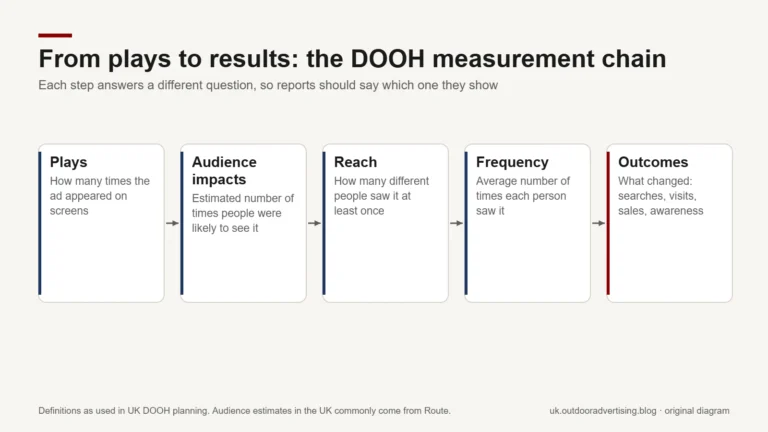
Campaign reporting should distinguish between: Media delivery: Whether the agreed advertisements ran. Estimated audience exposure: The reach, impacts and frequency generated by the measurement model. Business outcomes: Changes in relevant consumer or commercial activity. Attribution: Evidence connecting the campaign with observed results. These are related but different forms of information.
23. DOOH Media Plans for Product Launches
A product launch may require a different reach and frequency strategy from an ongoing brand awareness campaign.
New Consumer Product
The campaign may prioritise introducing the product to a broad relevant audience.
Automotive Launch
The media plan may focus on selected roadside and commercial environments connected to potential customers.
Retail Store Opening
The campaign may prioritise coverage and repeated exposure within a defined trading catchment.
Technology Launch
The campaign may combine DOOH awareness with digital channels that explain product features in more detail.
Film and Entertainment Release
A campaign may concentrate exposure during the period leading up to a confirmed release date. For entertainment campaigns, timing can be as important as audience quantity. Explore TRZY UK Movie Marketing and Entertainment Marketing.
24. DOOH Combined With Brand Activations
Digital outdoor advertising can also support a physical brand experience. For example, a product launch may use digital screens to introduce the campaign before an approved promotional activation.
- How the Two
- Activities
- Work Together
DOOH provides advertising visibility. An activation can provide direct product interaction or participation.
Example Campaign
A hypothetical consumer technology brand launches a new device.
The media plan uses suitable digital screens around a relevant shopping area. The brand also organises an approved product demonstration inside a shopping destination. The campaign could measure:
- Estimated
- DOOH reach
- Advertising impacts
- Verified screen delivery
- Demonstration attendance
- Qualified product enquiries
These results should be reported separately before drawing conclusions about their relationship. Explore TRZY UK Brand Activation and Experiential Activations.
25. Common Mistakes
When Reading a DOOH Media Plan Comparing Screen Count Instead of Audience Delivery More screens do not necessarily mean more unique reach.
- Treating
- Ad Plays as Human
- Impressions
An advertisement play is a delivery event, not a verified individual view.
Ignoring the CPM Definition
Different suppliers may use different impression or impact definitions.
- Adding
- Reach
- Across
- Screens
Combined reach must account for audience duplication.
Assuming Frequency Is the Same for Everyone
Average frequency does not describe the exposure of every individual.
Ignoring Share of Voice
A shared digital screen does not provide continuous advertising exposure.
- Using
- Continuous
- Screen
- Impact
- Figures for a Shared
- Booking
Actual impacts must reflect the relevant advertising schedule.
Choosing the Lowest CPM Automatically
Audience relevance and business objectives remain important.
Ignoring Target-Audience CPM
General audience impressions may not represent the people the advertiser wants to reach.
- Forgetting
- Production and Management
- Costs
A media price may exclude creative adaptation, animation and other services.
- Confusing
- Media Delivery With Sales
- Performance
Audience metrics do not prove the advertisement caused a purchase.
Failing to Request Proof of Play
Campaign delivery should be verified through appropriate reporting.
26. DOOH Media Plan Review Checklist
Before approving a digital outdoor advertising campaign, confirm the following.
Campaign Details Is the campaign objective clearly defined?
- Is the intended audience identified?
- Are geographic priorities confirmed?
- Are the campaign dates correct?
Media Inventory
Are the exact screen locations listed?
- Are the screen formats and dimensions provided?
- Are the operating hours confirmed?
- Are the locations relevant to the audience?
Audience Measurement Is the reach estimate provided?
- Are estimated impacts available?
- Is frequency calculated correctly?
- Is the measurement methodology identified?
- Does the plan include relevant target-audience data?
- Has overlapping reach been accounted for?
Digital Delivery What is the advertisement duration?
- What is the share of voice?
- What is the expected number of plays?
- Does the impact estimate reflect the actual schedule?
- What proof-of-play reporting will be supplied?
- Commercial
- Review Is the media
- CPM clear?
- What costs are included?
- Are creative and management fees listed?
- Are applicable taxes identified?
- What are the booking and cancellation conditions?
Reporting What delivery evidence will be provided?
How will under-delivery be handled?
- What business outcomes will be monitored?
- What measurement limitations apply?
A complete media proposal should answer these questions or clearly identify information that is not available.
27. How TRZY UK Supports DOOH Media Planning
Planning a digital out-of-home campaign involves more than choosing advertising screens. The campaign needs to reach an appropriate audience, use suitable formats and deliver advertising at the right time. Media plans should explain the expected reach, frequency and cost of audience delivery. They should also account for creative requirements, geographic priorities and campaign measurement. TRZY UK supports digital out-of-home advertising and integrated marketing campaigns across the United Kingdom. Relevant services include:
- OOH and DOOH campaign planning
- Audience and location strategy
- Digital media plan development
- Billboard advertising
- Creative campaign development
- CGI and anamorphic content
- Product launches
- Entertainment marketing
- Brand activations
- Campaign coordination and reporting
For each campaign, the appropriate media strategy should reflect the advertiser’s objectives, intended audience, campaign dates and available budget. Actual inventory, pricing and estimated audience delivery depend on the selected locations and current media data. Explore TRZY UK OOH and DOOH Advertising Services.
Frequently Asked Questions
What is CPM in DOOH advertising?
CPM stands for cost per thousand. It expresses the media cost for 1,000 defined advertising impressions or impacts. The underlying measurement basis should be clearly stated.
How is DOOH CPM calculated?
Divide the relevant media cost by the estimated impacts or impressions and multiply by 1,000.
What is reach in digital out-of-home advertising?
Reach estimates the number of different people who see an advertisement or campaign during a defined period.
What is frequency in DOOH?
Frequency is the average number of times reached individuals are estimated to see the campaign.
How do I calculate OOH frequency?
Divide the total estimated impacts by the estimated unique reach.
What are impacts in outdoor advertising?
Impacts represent the estimated total number of times people see an advertisement or campaign. They include repeated exposures.
Are DOOH impressions and ad plays the same?
No. An ad play records delivery of creative content, while audience impacts or impressions may estimate how many people saw or had a qualifying opportunity to see it.
What is Route in UK outdoor advertising?
Route is the established audience measurement currency for out-of-home advertising in Great Britain. It provides estimates of reach, impacts, frequency and other audience metrics.
How does Route estimate billboard audiences?
Route combines mobility information, audience counts, screen locations and visibility research to estimate people likely to see outdoor advertisements.
What is cover in OOH?
Cover is the percentage of a defined target population reached by a campaign.
How do you calculate OOH cover?
Divide estimated reach by the defined target population and multiply by 100.
What are GRPs in outdoor advertising?
Gross Rating Points express campaign exposure relative to a defined target population. They can be calculated by multiplying cover percentage by average frequency.
What is a good frequency for a DOOH campaign?
There is no universal ideal frequency. The appropriate level depends on the objective, audience, creative, duration and geographic strategy.
Is lower CPM always better?
No. A lower CPM may still deliver less relevant audience exposure. Audience quality and business objectives must be considered.
Does a higher screen count mean better reach?
Not necessarily. Screens can reach overlapping audiences, and different locations provide different levels of exposure.
What is share of voice on a digital billboard?
Share of voice is the portion of a digital screen’s advertising rotation allocated to a campaign.
What is an impression multiplier?
It is a measurement factor used in some DOOH systems to estimate the audience impressions associated with a digital advertisement play.
- Can I compare
- DOOH CPM with online advertising
- CPM?
Yes, as part of a wider analysis, but the different impression and audience measurement methodologies must be considered.
What is the difference between reach and frequency?
Reach estimates how many different people see a campaign. Frequency estimates how often those people see it on average.
How can I compare two DOOH media plans?
Compare audience relevance, screen locations, reach, impacts, frequency, CPM, display schedule, total costs and reporting arrangements.
Can DOOH support product launches?
Yes. Digital outdoor advertising can help introduce products, support retail openings and increase awareness of entertainment releases.
- How do I measure
- DOOH campaign
- ROI?
Review confirmed media delivery, estimated audience exposure and appropriate business outcomes. Direct attribution may require additional research and should not be assumed.
Can TRZY UK help plan DOOH advertising?
TRZY UK supports digital outdoor advertising strategy, location selection, creative development and campaign coordination across the United Kingdom.
Conclusion
Understanding CPM, reach and frequency is essential when comparing digital out-of-home advertising campaigns. CPM explains the cost of defined audience delivery. Reach estimates the number of different people seeing a campaign. Frequency indicates how often those people are exposed on average. Impacts describe the total volume of estimated audience exposure. However, these figures must be interpreted alongside the screen locations, advertising schedule, audience characteristics and campaign objectives. A low CPM does not automatically mean the campaign is effective. More screens do not necessarily create more reach, and digital advertisement plays should not be confused with estimated human impacts. For businesses planning DOOH campaigns in London, Manchester, Birmingham or other UK cities, a transparent media plan should connect the audience data with the actual advertising being purchased. The strongest proposal is one that explains what will run, where it will run, who it is expected to reach and what the complete campaign will cost. TRZY UK supports digital out-of-home advertising, billboard campaigns and integrated marketing activity across the United Kingdom. To discuss a DOOH campaign, explore TRZY UK’s OOH and DOOH Advertising Services or contact hello@trzy.co.uk.
Related guides
-
 Measurement & PerformanceHow to Measure DOOH: Reach, Impressions, Dwell Time and CPM
-
 Measurement & PerformanceDOOH Campaign Report Template: Essential KPIs and Questions
-
 Trends & ResearchHow AI Is Changing DOOH Creative and Media Planning