
How far in advance should you book billboard advertising in the UK? For a straightforward digital billboard campaign, it may be possible to arrange a booking at relatively short notice if suitable screens are available and approved artwork is ready. Printed billboards usually need more time for artwork submission, printing and posting. Bus advertising involves vehicle allocation and fitting, while premium landmark displays and custom installations may need months of planning. The right lead time therefore depends on the advertising format, location, campaign dates and production requirements. A retail promotion in one town has different scheduling needs from a nationwide product launch across London, Manchester and Birmingham.
A film campaign tied to a release date also has less flexibility than an ongoing brand awareness campaign. As a practical starting point, allow several weeks for standard outdoor advertising and begin planning premium or complex campaigns several months before launch. However, there is no single booking deadline that applies to every UK outdoor advertising site. Some locations can become unavailable long before the campaign begins. Others may have last-minute availability but require approved creative files within strict submission deadlines. This guide explains when businesses should start planning outdoor advertising, how lead times differ between formats, which deadlines matter and what to do when a campaign needs to launch quickly.
1. Why Outdoor Advertising Needs Advance Booking
Outdoor advertising uses physical locations or controlled digital advertising inventory. These locations have limited availability. A roadside billboard may be booked by another advertiser for the dates a brand wants. A digital display can have limited advertising rotation capacity. A bus campaign may require available vehicles and approved fitting arrangements. Advance planning helps businesses secure relevant inventory and meet production requirements.
- Five
- Reasons to Book
- Early
1. Advertising locations are limited.
A brand cannot assume its preferred billboard will be available when needed.
2. Production takes time.
Traditional posters require print-ready artwork and physical posting.
3. Creative approval may be required.
Media operators review advertising for technical compliance and content restrictions.
4. Premium dates attract demand.
Christmas, major product launches and important entertainment or sporting events can affect availability.
5. Complex campaigns have multiple dependencies.
A brand activation may require fabrication, insurance, risk assessments, technical equipment and venue approval. The objective is not simply to book as early as possible. It is to establish a reliable campaign timeline that provides enough time for each required activity.
2. What Is the Difference Between Booking Lead Time and Artwork Deadline?
These terms are related but should not be treated as interchangeable.
Booking Lead Time
Booking lead time is the period between confirming advertising inventory and the campaign start date. It involves securing the site, agreeing commercial conditions and confirming the display period.
Artwork Deadline
The artwork deadline is the last date by which approved creative material must be supplied to the media operator. For printed advertising, this deadline allows time for printing and posting. For digital advertising, it allows time for file validation, content approval and scheduling.
Example
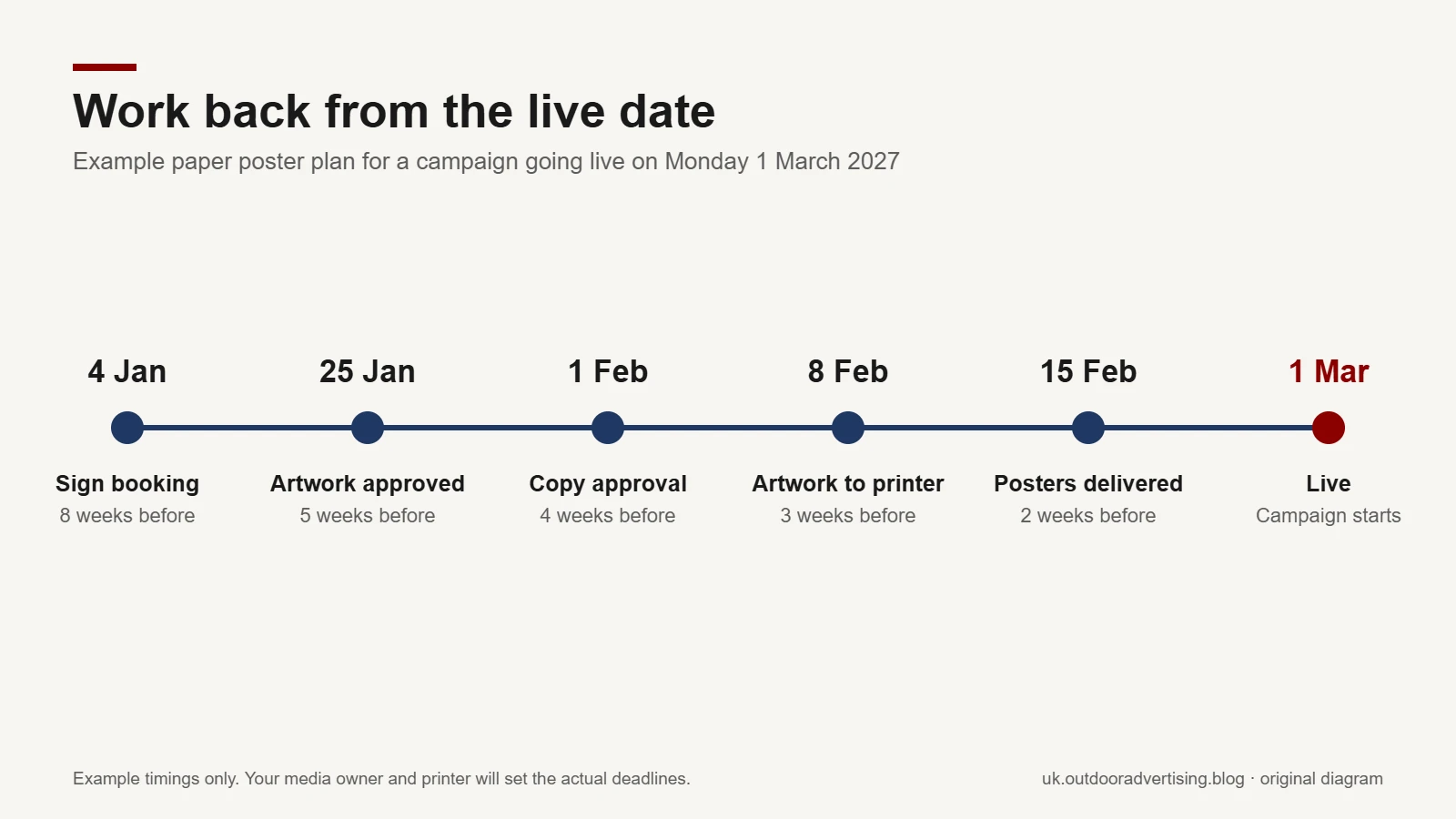
A business wants a printed billboard campaign to begin on 1 March. It may reserve the advertising space several weeks in advance.
However, the finished artwork may need to reach the operator approximately two weeks before launch. Booking the billboard does not automatically mean the artwork can be submitted on the night before the campaign starts.
A Third Deadline: Internal Approval
Advertisers also need time to approve the creative internally. This can involve marketing, legal, brand, product and management teams. A campaign can miss its supplier artwork deadline because of late internal sign-off. The most effective timeline includes all three stages:
1. Inventory booking
2. Internal creative approval
3. Supplier artwork delivery
3. Recommended Outdoor Advertising Booking Lead Times
The following table provides practical planning windows for UK advertising campaigns. These are recommendations for project planning rather than guaranteed minimum booking periods.
| Advertising format | Recommended planning window | Key tasks |
|---|---|---|
| Standard digital billboard | 2–4 weeks | Site selection, booking, artwork approval |
| Traditional roadside billboard | 3–6 weeks | Booking, printing, posting |
| Bus shelter advertising | 3–6 weeks | Site selection and artwork production |
| Standard bus panels | 4–6 weeks | Fleet booking, print and fitting Recommended planning |
| Full bus wrap | 6–8 weeks or longer | Vehicle allocation, design, print and installation |
| Railway or transit advertising | 4–8 weeks | Inventory booking and operator approval |
| Premium landmark digital | 3–6 months screen | Availability, commercial approval and production |
| Complex dynamic DOOH | 6–10 weeks | Creative development, data testing and scheduling |
| Bespoke brand activation | 8–12 weeks or longer | Permissions, fabrication, staffing and operations |
The timeline should be extended when the campaign involves multiple cities, complex fabrication, strict launch dates or unusual approvals. Some standard formats may be available much sooner. Advertisers should ask for the actual booking and creative deadlines when requesting inventory.
4. How Early Should You Book a Traditional Billboard?
Traditional printed billboards are commonly booked for specific posting cycles. These include formats such as:
- 6-sheet posters
- 48-sheet roadside billboards
- 96-sheet billboards
- Other printed outdoor advertising panels
For ordinary campaigns, a planning window of three to six weeks is a useful starting point. This allows time to identify suitable locations, confirm prices, secure inventory and prepare artwork.
Can a Printed Billboard Go Live in Two Weeks?
Sometimes. Published UK supplier information indicates that certain standard printed campaigns can go live approximately two to three weeks after booking. However, this depends on inventory availability, production arrangements and when finished artwork is supplied. A short lead time should not be treated as a guaranteed service level.
Why Print Deadlines Matter A UK outdoor media owner lists an artwork delivery deadline of approximately ten working days for selected printed 48-sheet and 96-sheet campaigns. Other printed formats have different submission requirements. If the artwork arrives late, the advertisement may not be posted on the intended date.
Planning Example
A business wants a four-week billboard campaign starting on 1 April. A reasonable schedule would be: Early February: Confirm objective, locations and budget. Mid-February: Review proposals and reserve preferred advertising sites. Late February: Complete campaign artwork. Early to mid-March: Obtain final approval and submit print-ready creative within the operator’s deadline. 1 April: Begin the advertising period, subject to the contracted posting arrangements. This approach creates additional room for revisions and unexpected production issues.
5. How Early Should You Book Digital Billboard Advertising?
Digital out-of-home advertising, or DOOH, can offer shorter production lead times because no physical poster printing is required. However, the absence of printing does not remove the need for booking and creative approval.
Can Digital Billboards Be Booked at Short Notice?
Yes, some digital advertising inventory can be activated within days when suitable space is available and approved creative is ready. Published UK supplier information includes examples of digital billboards going live in as little as 48 hours. This is a possibility for selected inventory, not a universal commitment.
Why Is Early Booking Still Useful?
A brand may require:
- A particular road
- A selected shopping centre
- A specific city-centre screen
- Advertising during a major event
- A defined share of voice
- Multiple screens operating together
Even if digital content can be uploaded quickly, the preferred advertising inventory may already be sold.
Digital Artwork Deadlines Vary
Different media owners publish different creative submission arrangements. One major UK operator requests artwork two weeks before the start date for specified digital formats. Another publishes a five-working-day advance deadline for standard linear digital creative under its digital guidelines.
Certain more complex campaigns require longer lead times. Therefore, it is unsafe to assume every digital billboard accepts artwork 24 or 48 hours before launch.
Practical Recommendation
For ordinary digital billboard campaigns, begin planning around two to four weeks ahead where possible. For premium locations or complex scheduling, allow more time.
6. How Early Should You Book Bus Advertising?
Bus advertising involves physical media attached to operational vehicles. Available formats include:
- Bus rears
- Supersides
- T-sides
- Mega rears
- Full vehicle wraps
- Interior panels
The booking timeline must account for vehicle and fleet availability.
Standard Bus Panels
Allow approximately four to six weeks for comfortable planning. This provides time for:
1. Choosing the campaign geography
2. Reviewing available fleets
3. Confirming vehicle quantities
4. Approving artwork
5. Printing the panels
6. Scheduling fitting
Some standard campaigns may be completed faster.
- Why Bus Advertising Is Not
- Like a Fixed
- Billboard
Buses move through operating areas, and their availability can depend on depot and fleet arrangements. An advertiser may also need to confirm whether the campaign can target specific routes.
Can I Guarantee a Particular Bus Route?
Not automatically. Some media bookings allow geographic or depot selection, while exact route commitments depend on the operator’s arrangements. A campaign requiring a particular route should confirm that condition before booking.
7. Full Bus Wrap Booking Lead Times
Full bus wraps require substantially more production planning than standard panels. The vehicle must be assessed for its dimensions and available branding surfaces. Creative material needs to account for windows, doors, lights, wheel arches and other features.
Recommended Timeline Allow approximately six to eight weeks or more for a full bus wrap. The actual requirement may be longer for complex campaigns or limited vehicle availability.
Production Stages Stage 1
Vehicle allocation Confirm the bus type and booking arrangements.
- Stage 2: Creative specifications Obtain the correct vehicle templates.
- Stage 3: Artwork development Develop content around the vehicle’s shape and restrictions.
- Stage 4: Approval Secure the necessary operator and brand approvals.
- Stage 5: Production Print and prepare the approved wrap material.
- Stage 6: Fitting Schedule installation with the relevant depot or vehicle team.
- Stage 7: Launch Confirm the campaign is operational and obtain appropriate installation evidence.
Why Last-Minute Wraps Are Risky
Even if the media inventory is available, the production schedule may prevent the campaign from launching on the requested date. A fixed event or film release date can make this especially important.
8. Railway, Underground and Tram Advertising Lead Times
Transport advertising can involve posters, digital displays and specialist promotional formats. Examples include:
- London Underground advertising
- Railway station posters
- Digital station screens
- Tram advertising
- Bus station advertising
- Station dominations
- Approved transport activations
Standard Transport Formats
A planning period of four to eight weeks is a useful general starting point. Some standard campaigns may require less time.
Why Transport Campaigns Can Be Complex
The advertising may be subject to requirements from:
- Media rights holders
- Transport operators
- Station managers
- Property owners
- Safety teams
- Creative approval teams
London Underground
Some published UK buying guidance describes typical booking-to-live timelines of approximately two to four weeks for selected standard Underground advertising. More complex station takeovers, special formats or premium inventory may require longer.
Specialist Station Campaigns
A campaign involving an entire station environment or physical installation should begin much earlier than a conventional poster booking. The proposed format and scope should determine the timeline.
9. Landmark Digital Billboard Booking Lead Times
Premium landmark advertising is different from ordinary digital billboard inventory. These displays may have limited advertising availability, special creative requirements and significant commercial demand.
Examples
- of Landmark
- Environments
Brands may investigate selected prominent locations in:
- Central London Major shopping districts
- Important transport hubs
- High-profile entertainment destinations
- Leading regional city centres
Why Book Several Months Ahead?
Potential reasons include:
- Limited premium inventory
- Seasonal demand
- Major event schedules
- Additional creative approvals
- Technical specifications
- Longer commercial negotiations
- Special content production
For premium campaigns, starting three to six months ahead may provide more flexibility. This is a planning recommendation rather than a universal supplier minimum.
Do Landmark Screens Require Special Creative?
Some displays have unusual dimensions or screen arrangements. Creative may need to be developed specifically for the location. A large digital billboard should not automatically be described as suitable for 3D anamorphic content. The geometry, viewing position and media owner approval must be confirmed. Explore TRZY UK Anamorphic CGI Experiences.
10. Dynamic DOOH: Why Complex Creative Needs More Time
Dynamic digital out-of-home advertising changes creative according to approved scheduling conditions. Depending on the campaign, these may include:
- Time of day
- Date
- Weather conditions
- Temperature
- Geographic location
- Relevant live data
- Product availability
- Why Dynamic
- Campaigns Need
- Additional
- Planning
The project may involve:
- Content logic
- Data sources
- Technical integration
- Multiple creative versions
- Default creative
- Testing Approval Fallback arrangements
Published Operator Guidance
One major UK outdoor media owner’s published digital management policy advises allowing 20 working days for dynamic campaigns. This is significantly different from the short activation times sometimes available for simple digital artwork.
What Is Default Creative?
Default creative is an approved advertisement that can display when particular dynamic conditions are not met. For example, a weather-responsive campaign may show one creative during rain and another during dry weather. If the required data is unavailable, the system should have a suitable approved fallback.
Recommended Planning Allow six to ten weeks for complex dynamic DOOH projects where possible. The exact timeline depends on the creative logic, data integrations and operator requirements.
11. How Early Should You Book Outdoor Advertising for Christmas?
Christmas is an important advertising period for retail, consumer products and entertainment. Demand for selected media locations can increase as brands seek visibility during the holiday shopping season.
When Should Christmas Planning Begin?
For premium December advertising, planning several months in advance is sensible. A practical approach is to begin investigating locations in late spring or summer for major campaigns. Smaller local campaigns may still find inventory later, but selection can become more limited.
- Why Christmas
- Campaigns Need
- Early Booking
Popular retail locations may sell out. National brands may reserve premium inventory.
Creative production has seasonal deadlines. Public holidays can reduce working days. Multiple teams may need to approve content. Retail offers may require accurate promotional information.
Example
- Christmas Planning
- Schedule
- June to August:
Define campaign objectives and investigate premium locations. September: Finalise the media strategy and confirm important bookings. October: Approve creative content and production requirements. November: Submit final materials and prepare for launch. Late November to December: Run the advertising campaign according to the approved schedule. This is an illustrative planning sequence, not a required industry timetable.
12. Black Friday and January Sales Booking
Retail promotions connected to Black Friday and January sales have strict commercial dates. An advertisement launching after the relevant promotion may have limited value.
Black Friday Advertising
Brands should identify the required advertising dates and confirm inventory well ahead of the promotional period. Premium shopping centre and roadside locations may attract additional demand.
January Sales
January campaigns often require preparation before the Christmas holiday period. Artwork approval and media booking should account for reduced working days around public holidays.
- Why Accurate
- Creative
- Matters
Price promotions, discounts and offer dates must be correct.
The creative should be approved against applicable advertising rules. If promotional terms change after artwork submission, additional production or scheduling work may be required.
13. Sporting Events and Festival Advertising
Major sporting events, concerts and festivals can create distinctive advertising opportunities. They can also affect media availability and operational access.
Event-Related Advertising Locations
Brands may consider suitable advertising around:
- Transport hubs
- Major roads
- Retail districts
- Entertainment areas
- Approved event approaches
- Important
- Booking
- Considerations
- Check:
- Confirmed event dates
- Media availability
- Audience relevance
- Road closures
- Public transport changes
- Installation access
- Advertising restrictions
- Event sponsorship rights
Official Sponsorship vs Outdoor Advertising
A normal billboard booking near a stadium does not make the advertiser an official event sponsor. Brands should avoid using protected event branding without the necessary rights.
When to Start Planning
For major events and high-profile media, begin planning several months ahead where possible. For smaller local events, the necessary lead time depends on the available inventory and production.
14. Film Release and Entertainment Campaign Timelines
Entertainment advertising often operates around fixed release dates. A film may have a confirmed theatrical release, streaming premiere or promotional event schedule. Outdoor advertising should align with those dates.
- Eight-Week
- Illustrative
- Film Campaign Timeline
Eight weeks before release Confirm the marketing objective, target cities and preferred media formats. Six weeks before release Review outdoor inventory and reserve relevant locations. Four weeks before release Finalise creative concepts and obtain approved artwork. Two weeks before release Submit the finished creative according to supplier deadlines and confirm delivery arrangements. Release week Verify that the advertising runs as booked. After release Review media delivery and relevant campaign outcomes.
What If the Release Date Changes?
A release-date change can affect artwork, campaign scheduling and media commitments. The contract should establish whether dates or creative can be amended. Late changes may involve additional costs or reduced availability. Explore TRZY UK Movie Marketing and Entertainment Marketing.
15. Product Launch Advertising: A Practical Booking Timeline
Product launches often involve multiple activities. Outdoor advertising may run alongside digital promotion, a launch event and brand activation.
- Ten-Week
- Product Launch
- Example
| Timing | Activity |
|---|---|
| 10 weeks before launch | Define objectives, audience and budget |
| 8 weeks | Investigate OOH locations and formats |
| 7 weeks | Review media plans and shortlist inventory |
| 6 weeks | Secure important bookings |
| 5 weeks | Develop creative and technical assets |
| 4 weeks | Approve campaign messages |
| 3 weeks | Complete production and media coordination |
| 2 weeks | Deliver artwork to relevant operators |
| 1 week | Confirm scheduling and launch arrangements |
| Launch week | Verify advertising delivery |
This example assumes a standard multi-format campaign.
A complex installation or major landmark screen may require a significantly longer schedule.
16. Brand Activations Need a Separate Timeline
A brand activation is different from booking a standard outdoor advertisement. Activations may require a physical space, promotional staff, structures, technology and audience interaction.
- Possible
- Formats
- Product sampling
- Promotional installations
- Pop-up experiences
- Interactive games
- Retail demonstrations
- Temporary brand environments
- Entertainment promotions
Key Dependencies
These may include:
- Venue approval
- Local authority permissions
- Insurance Risk assessments
- Fabrication Technical production
- Transport Installation Staffing Power and connectivity
Site inspections Removal and reinstatement
How Early Should You Start?
Allow eight to twelve weeks or more for many bespoke activations as a conservative starting point. Simple, pre-approved promotional formats may require less. Large structures, unusual technology or multiple approval bodies can require significantly more. Explore TRZY UK Brand Activation and Experiential Activations.
17. Can You Book Outdoor Advertising at the Last Minute?
Sometimes. Short-notice campaigns may be possible where appropriate inventory is available. Digital advertising can be particularly useful because it does not require physical poster production. However, availability, content approval and commercial conditions still matter.
What to Prepare for an Urgent Booking Provide:
1. Brand name
2. Campaign objective
3. Target city or area
4. Required start date
5. Campaign duration
6. Budget
7. Preferred media format
8. Final creative artwork, if available
9. Required content approvals
10. Contact details for rapid decisions
What Could Make an Urgent Booking Difficult?
Potential obstacles include:
- No available media inventory
- Unapproved artwork
- Restricted product categories
- Complex content scheduling
- Missing brand approval
- Payment or contracting delays
- Custom production requirements
Better Short-Notice Strategy
Instead of insisting on one specific unavailable screen, consider alternative suitable locations. The decision should still prioritise audience relevance. An available screen is not automatically a good advertising investment.
18. What Happens If Billboard Artwork Is Submitted Late?
The consequences depend on the media owner’s booking conditions. Possible outcomes include:
- Delayed campaign launch
- Reduced advertising exposure
- Late creative charges
- Use of default creative
- Additional production costs
- Missed promotional dates
Some UK digital media-owner policies explicitly warn that late creative delivery may delay first playout without compensation.
How to Avoid This Problem
Establish the artwork deadline when confirming the media booking. Create an internal approval date several working days earlier. Check the final creative against the operator’s technical specifications before submission.
What If Artwork Is Rejected?
The campaign may require revisions. For fixed-date campaigns, late rejection can create substantial scheduling pressure. Creative compliance should be considered during development rather than only at final submission.
19. Creative Approval and UK Advertising Rules
Outdoor advertising content must comply with applicable advertising rules and media-owner policies. The UK CAP Code includes requirements concerning misleading advertising, substantiation and other content standards. Some product categories have additional restrictions.
What Should Brands Check Before Booking?
Consider:
- Product claims
- Pricing accuracy
- Promotional dates
- Licensed imagery
- Copyright
- Brand approvals
- Restricted product categories
- Media-owner acceptance policies
Why Approval Can Affect Lead Time
A simple retail message may require fewer revisions than a campaign involving complex product claims, regulated products or custom creative. The timeline should reflect the actual approval work required.
Non-Standard Advertising Structures
New advertising structures may require additional planning consent or other approvals. These processes should not be confused with a standard media booking on an existing authorised billboard.
20. How to Build a Reverse Campaign Timeline
Reverse scheduling starts with the required launch date and works backward. This is especially useful for fixed-date campaigns.
Example: Campaign Starts on 1 September 1
- September: Advertising begins.
- Mid-August: Final artwork has been delivered within the operator’s deadline.
- Early August: Final brand and legal approvals are complete.
- July: Media inventory is secured and creative specifications are confirmed.
- June: Audience strategy, formats and budget are developed. The dates are illustrative. Actual supplier deadlines must replace the assumptions before the schedule is approved.
Add Approval Buffers
Do not place internal sign-off on the exact supplier deadline.
Allow reasonable time for corrections and technical validation.
Identify the Critical Path
The critical path is the sequence of tasks that must finish on time for the campaign to launch. For a printed billboard, it may be: Site booking → artwork approval → printing → posting. For a dynamic digital campaign, it may be: Screen booking → data integration → creative testing → operator approval → scheduling. The schedule should identify which tasks can run in parallel and which depend on earlier approval.
21. How Early Booking Affects Advertising Costs
Booking early can improve the selection of available media inventory. However, it does not guarantee the lowest price.
- Potential
- Benefits
- Early planning may allow:
- More location options
- Time to compare quotations
- Better creative coordination
- Fewer production emergencies
- More flexibility around campaign dates
Does Last-Minute Inventory Cost Less?
Not necessarily. Some media may become available close to the campaign start, but the commercial conditions vary. A discount should not be assumed.
Can Last-Minute Booking Increase Costs?
Yes, especially if the campaign requires urgent production, express delivery, additional staffing or special creative approvals.
- The Better
- Budgeting
- Approach
Compare the complete cost of the available options. A cheaper location may be less suitable for the intended audience. A more expensive option may offer better campaign relevance. The timing decision should reflect both cost and marketing value.
22. Multi-City Outdoor Advertising Lead Times
Campaigns across several UK cities require additional coordination. For example, a product launch might involve:
London Manchester Birmingham Leeds Glasgow Cardiff
Each market can have different inventory, creative requirements and booking arrangements.
What Makes Multi-City Campaigns More Complex?
- Different media rights holders
- Different technical specifications
- Different local audiences
- Separate pricing and availability
- Multiple artwork versions
- Different installation schedules
Different reporting arrangements
Recommended Planning Window
For a standard multi-city OOH campaign, begin planning approximately eight to twelve weeks ahead where possible. For major national launches or campaigns involving premium sites and special production, start earlier.
- Maintain
- One
- Master
- Schedule
The campaign should have one central timeline showing:
- City Advertising site
- Booking status
- Creative specifications
- Artwork deadline
- Start date
- Production status
- Approval status
- Delivery verification
This reduces the risk of one city launching late because its artwork or inventory was overlooked.
23. A Practical Outdoor Advertising Booking Checklist
Before confirming the campaign, review the following.
Campaign Brief Objective is defined. Intended audience is clear. Campaign geography is selected.
Required launch date is confirmed. Available budget is established.
Media Selection Exact advertising sites have been reviewed. Formats match the objective. Audience estimates are available where applicable. Site availability has been confirmed. Commercial terms are understood.
Creative Production Technical specifications are available. Artwork responsibility is assigned. Brand approval is scheduled. Legal review is arranged where necessary. Supplier delivery deadline is recorded.
Operations Printing requirements are confirmed. Installation responsibilities are assigned. Transport or venue arrangements are understood. Necessary permissions have been assessed. Contingency is available for approved changes.
Campaign Launch Booking confirmation is documented. Final artwork has been accepted. Display dates are confirmed. Delivery verification is agreed.
Reporting requirements are defined.
24. Questions to Ask Before Booking Outdoor Advertising
The following questions can be included in an advertising enquiry. Inventory
1. Is the requested location available on the required dates?
2. Are there suitable alternatives?
3. Is the inventory subject to a minimum booking period?
4. When must the booking be confirmed?
Creative
5. What artwork dimensions and formats are required?
6. When is the final artwork due?
7. Does the operator require additional content approval?
8. Can creative be changed after booking?
Production
9. Are printing and installation included?
10. How long does production take?
11. What happens if approved artwork is delivered late?
12. Are there additional charges for urgent production?
Commercial Terms
13. Is the quoted price inclusive of all relevant fees and VAT?
14. What are the cancellation conditions?
15. Can campaign dates be changed?
16. What happens if the location becomes unavailable?
Delivery
17. When will the campaign be confirmed as live?
18. What proof of posting or proof of play is provided?
19. How are missed displays handled?
20. Who is responsible for resolving campaign issues?
Answers should be obtained before approving a fixed-date campaign.
25. Common Outdoor Advertising Booking Mistakes
Waiting Until the Week Before Launch
Some digital inventory may be available, but printed and complex formats often need more time.
Confusing Booking and Artwork Deadlines
Securing media space does not mean creative can be submitted at any time.
- Assuming
- Every Digital Screen Can Go Live in 48
- Hours
Operator requirements vary.
Ignoring High-Demand Periods
Christmas, major events and premium retail periods can limit availability.
Choosing Media Before Defining the Audience
Available inventory should not replace sound audience planning.
- Leaving
- Legal
- Approval
- Too Late
Creative rejection can delay the campaign.
- Forgetting
- Print and Fitting
- Time
Traditional posters and bus panels require physical production.
- Booking a Full Wrap
- Like a Standard
- Bus Rear
Vehicle wraps need different production arrangements.
- Using
- Outdated
- Creative Specifications
The media owner should provide current templates.
Overlooking Contract Terms
Cancellation, amendment and missed-display arrangements should be understood before payment.
Failing to Coordinate Multiple Cities
Different markets may have different creative and operational deadlines.
Not Checking Delivery
Brands should request evidence that the campaign ran as booked.
26. How TRZY UK Supports Outdoor Advertising Campaign Planning
Outdoor advertising campaigns require coordination between strategy, media availability, creative production and execution. For brands planning campaigns across several formats or locations, the timing of these activities can be important. TRZY UK supports outdoor advertising and experiential marketing campaigns across the United Kingdom. Relevant services include:
- OOH campaign planning
- Digital out-of-home advertising
- Audience and location strategy
- Media placement coordination
- Creative development
- CGI and anamorphic content
- Product launches
- Entertainment marketing
- Brand activations
- Campaign execution and reporting
For each campaign, the proposed timeline should reflect the advertising objective, preferred locations, launch date and available budget. Exact booking deadlines depend on the selected media inventory and supplier requirements. Explore TRZY UK OOH and DOOH Advertising Services.
Frequently Asked Questions
How far in advance should I book outdoor advertising in the UK?
For standard campaigns, begin planning several weeks ahead. Premium, seasonal or bespoke campaigns may require several months. The exact lead time depends on format, inventory and approvals.
How early should I book a traditional billboard?
Three to six weeks is a useful planning window for many standard campaigns, although some suppliers can deliver faster and high-demand sites may need earlier booking.
Can I book a digital billboard for tomorrow?
Some digital inventory can be activated at short notice, but availability and approved creative are required. Next-day delivery is not guaranteed.
Can a digital billboard go live within 48 hours?
Selected UK inventory may support rapid activation, but the media owner’s creative delivery policy and commercial conditions determine what is possible.
How long does billboard printing take?
Production schedules vary by supplier and format. Some operators require finished artwork approximately ten working days before the start of printed campaigns.
How early should I book bus advertising?
Allow around four to six weeks for standard panels as a practical planning recommendation. The actual timeline depends on fleet availability, artwork and fitting.
How long does a full bus wrap take?
A full bus wrap may need six to eight weeks or longer for vehicle allocation, approval, production and installation.
- When should
- I book
- Christmas billboard advertising?
For premium Christmas locations, begin planning several months in advance. Smaller local campaigns may have availability closer to the season.
- How early should
- I book
- Black Friday advertising?
Start well ahead of the promotional date, particularly for popular retail and transport inventory. Confirm the media and artwork deadlines with the operator.
- How early should
- I book a premium
- London billboard?
For high-profile landmark inventory, planning three to six months in advance can be sensible. Some locations may have different availability and booking arrangements.
How much notice does dynamic DOOH require?
Complex dynamic campaigns can need several weeks for production and testing. Published operator guidance for some dynamic work specifies 20 working days.
Can I change billboard artwork after booking?
Possibly. Changes depend on the format, delivery deadlines and booking terms. Printed replacements may require additional production costs.
What happens if artwork is submitted late?
The campaign may be delayed, creative changes may be restricted or contractual charges may apply. Some operators do not compensate for impressions lost through late artwork delivery.
Are traditional billboards booked in two-week cycles?
Many standard UK printed billboard products use two-week booking cycles, although other arrangements are available.
Can I book outdoor advertising for a single day?
Some digital and special advertising products may support short periods, subject to inventory and minimum booking requirements.
Is booking early cheaper?
Not necessarily. Early booking can improve the range of available locations but does not guarantee a lower price.
Can I advertise near a major sporting event?
Suitable outdoor media may be available around relevant locations, subject to permissions and inventory. A standard media booking does not provide official sponsorship rights.
How early should I plan a brand activation?
For bespoke physical activations, eight to twelve weeks or longer can be a sensible starting point. Complex installations may require additional time.
Can I run advertising across several UK cities at once?
Yes. Multi-city campaigns can be coordinated with common creative and reporting, although media and production deadlines may vary.
What is the difference between booking confirmation and artwork approval?
Booking confirmation secures the media under agreed terms. Artwork approval confirms the creative meets the relevant requirements for display.
Do outdoor advertising campaigns need planning permission?
Some new structures require advertisement consent or other approvals. Booking an existing authorised site is different from creating a new advertising installation.
How do I avoid missing an outdoor advertising deadline?
Use a reverse campaign timeline that identifies the booking date, internal approval dates, supplier artwork deadline, installation arrangements and launch date.
Can TRZY UK help organise UK outdoor advertising campaigns?
TRZY UK supports OOH and DOOH media planning, creative coordination and campaign execution across the United Kingdom.
Conclusion
The right time to book outdoor advertising in the UK depends on the advertising format, preferred location, campaign dates and production requirements. Standard digital advertising can sometimes be arranged quickly, while printed billboards and bus panels require additional production and installation. Full vehicle wraps, premium landmark screens, complex dynamic DOOH and bespoke brand activations generally benefit from earlier planning. Advertisers should also distinguish between reserving the advertising inventory and delivering approved artwork. A campaign booked in advance can still launch late if its creative is not ready by the required deadline. The most reliable approach is to work backward from the intended launch date and confirm all supplier requirements before finalising the schedule.
For businesses planning retail promotions, film releases, product launches or national awareness campaigns, early coordination provides more room to compare locations, develop creative and manage approvals. TRZY UK supports businesses with outdoor advertising planning, digital billboard campaigns and integrated promotional activities across the United Kingdom. To discuss an upcoming campaign, explore TRZY UK’s OOH and DOOH Services or contact hello@trzy.co.uk.
Related guides
-
 Costs, Buying & PermissionsHow to Book Billboard Advertising in the UK: Step-by-Step
-
 Costs, Buying & PermissionsBillboard Advertising for Small UK Businesses: Is It Worth It?
-
 Costs, Buying & PermissionsBillboard Production Costs: Design, Print, Installation and VAT