

How do you measure the return on investment from experiential marketing? A brand activation can attract hundreds of visitors, generate product demonstrations and create engaging photographs. But those results do not automatically establish that the campaign generated profitable business. A shopping centre product launch may distribute thousands of samples without knowing whether recipients later purchase the product. An automotive showcase may record hundreds of visitors but only a small number of qualified test-drive enquiries. A film-themed installation might attract attention without providing credible evidence of additional ticket sales. This is why experiential marketing measurement needs more than attendance figures and social media engagement. A useful evaluation should distinguish between campaign delivery, audience participation, marketing outcomes and incremental business impact. These stages answer different questions. Did the activation run properly? How many people interacted with it? Did the intended audience understand or try the product? Did the business receive relevant enquiries or purchases? What additional value can reasonably be attributed to the campaign? This guide explains how to measure experiential marketing ROI in the UK. It includes practical KPI formulas, realistic worked examples, attribution methods, brand lift measurement and a reusable reporting template. It also explains what marketers can and cannot prove using event footfall, QR codes, customer surveys and sales data.
1. What Is Experiential Marketing ROI?
Experiential marketing ROI is a measure of the financial return generated by an experiential marketing investment.
Experiential marketing uses planned experiences to encourage audiences to interact with a brand or product. Examples include:
- Product demonstrations
- Sampling campaigns
- Retail brand activations
- Pop-up experiences
- Interactive installations
- Automotive showcases
- Technology activations
- Promotional roadshows
- Entertainment experiences
An activation can support awareness, product understanding, enquiries, purchases and longer-term customer relationships. Not every benefit can be converted reliably into money.
What Does ROI Actually Measure?
A conventional financial ROI calculation compares incremental profit with the total campaign expenditure. Experiential marketing ROI (%) = [(Incremental contribution profit − campaign cost) ÷ campaign cost] × 100 For example, if a campaign costs £10,000 and produces £15,000 in credibly established incremental contribution profit before deducting campaign expenditure: ROI = [(£15,000 − £10,000) ÷ £10,000] × 100 ROI = 50% This is a hypothetical calculation. It is not a typical return or a guaranteed result. The most difficult part is usually not calculating the percentage.
It is establishing how much of the additional profit was actually caused by the campaign.
2. Why Measuring Brand Activation ROI Is Difficult
Experiential marketing can influence people in ways that are not immediately visible in sales data. Someone may try a product at an activation and purchase it several weeks later. Another visitor may recognise the brand during a later online search. A participant might recommend the product to someone who never attended. These behaviours can be valuable, but they are not always easy to isolate.
Common Measurement Challenges
- Delayed purchases: Customers may buy after the reporting period.
- Multiple marketing channels: Digital advertising, PR, social content and outdoor media may run at the same time.
- Existing demand: Some visitors may already have planned to purchase.
- Limited customer tracking: Not everyone wants to provide personal details.
- Venue audience uncertainty: Total footfall does not reveal exactly who engaged with the experience.
- Small sample sizes: A short activation may not produce enough data for a reliable statistical comparison.
The Main Risk
A campaign report may present all sales or enquiries recorded during the campaign as though the activation caused them. This can substantially overstate the results. A more credible approach identifies exactly what has been measured and how confidently it can be linked to the campaign.
3. Four Levels of Experiential Marketing Measurement
A useful evaluation can be divided into four levels.
| Level | What it measures | Example |
|---|---|---|
| 1. Delivery | Whether the planned activity ran | Five activation days completed |
| 2. Participation | What visitors did | 1,500 product trials |
| 3. Outcomes | Relevant changes or responses | 120 qualified enquiries |
| 4. Incremental impact | Additional outcomes caused by the activity | Estimated incremental profit from a credible comparison |
These levels should not be confused. A verified product trial is evidence of participation. A completed enquiry is an observed response. An incremental enquiry is one that would not have occurred without the campaign. These can be different numbers.
Why the Distinction Matters
Suppose an activation records 100 purchases. It would be inaccurate to assume all 100 purchases were caused by the activity. Some customers may have purchased anyway. Without a suitable comparison, the campaign can report the 100 observed purchases but should not claim that all were incremental.
4. Set the Measurement Objective Before the Campaign
The first step is defining what success means. A sampling campaign has different objectives from a corporate product demonstration.
Common Objectives
Brand awareness: Introduce a brand to an intended audience.
- Product trial: Encourage people to experience a product.
- Product education: Improve understanding of important features.
- Engagement: Generate relevant participation.
- Qualified enquiries: Encourage suitable potential customers to request further information.
- Sales: Support additional purchases.
- Market research: Gather reliable consumer feedback.
- Choose
- One
- Primary KPI
A campaign can have several useful metrics, but its primary KPI should reflect its main objective. For example: Primary objective: Encourage product trial. Primary KPI: Verified product trials completed. Secondary KPIs: Product feedback and qualified enquiries.
- Avoid
- Measuring
- Everything
- Equally
A dashboard with dozens of metrics may appear detailed while failing to explain whether the campaign achieved its purpose. Begin with the business decision that the report needs to support.
5. The Most Useful Experiential Marketing KPIs
The following KPIs can be useful depending on campaign objectives.
| KPI | What it tells you |
|---|---|
| Verified visitors | Recorded visits to the activation |
| Unique participants | People recorded as participating, where deduplication is possible |
| Product trials | Completed product experiences |
| Demonstration completions | Finished demonstrations |
| Participation rate | Proportion of a defined audience that participated |
| Cost per participant | Campaign spend per recorded participant |
| Qualified enquiries | Relevant expressions of commercial interest |
| Cost per qualified lead | Spend per qualified enquiry |
| Conversion rate | Proportion completing a defined action |
| Brand awareness lift | Change in brand awareness between comparable measurements |
| Incremental sales | Additional sales credibly attributed to the campaign |
| Incremental contribution profit | Additional contribution generated before campaign cost |
| Financial ROI | Incremental contribution relative to total expenditure |
Not every campaign needs all these measures. A consumer awareness experience may prioritise brand research. A B2B product demonstration may prioritise qualified meetings and subsequent sales opportunities. The KPI selection should follow the campaign objective.
6. How to Measure Participation
Participation is one of the most direct outputs of a physical activation. However, it must be defined clearly.
What Counts as a Participant?
Possible definitions include:
A person completing a product demonstration
- A visitor trying a sample
- Someone finishing a branded game
- A visitor attending a workshop
- A guest completing a guided experience
Why Definitions Matter
A person walking past a stand is not necessarily a participant. A visitor who enters a pop-up but does not interact with the product may be a visitor rather than a completed participant.
Avoid Double-Counting
Some people may take part more than once. The campaign should distinguish between: Total interactions: Every recorded interaction, including repeats. Unique participants: Distinct people, where they can be counted reliably and lawfully.
Example
A hypothetical activation records 1,400 interactions. If 100 are confirmed repeat interactions, the recorded unique participants would be 1,300. However, this distinction should only be reported if the counting method can genuinely identify repeats. Do not invent a deduplication adjustment.
7. Cost per Participant
Cost per participant is a simple campaign efficiency metric.
Formula
Cost per participant = Total campaign cost ÷ verified participants
Worked Example
A three-day activation costs £9,000. The campaign records 1,500 verified participants. £9,000 ÷ 1,500 = £6 per participant This means the campaign spent £6 for each recorded participant.
What It Does Not Mean
It does not mean:
- Each participant became a customer.
- Each participant generated £6 of value.
- The campaign made a profit.
- The experience was more effective than another campaign.
Comparing Two Activations Suppose: Campaign
- A: £6 per participant.
- Campaign B: £10 per participant. Campaign A appears more efficient on participation cost alone. However, Campaign B might attract people with greater product interest or generate more qualified enquiries. Both cost and participant quality should be reviewed.
8. Participation Rate and Conversion Rate
Participation rate can help explain how effectively an activation encourages people to engage.
Formula
Participation rate = Participants ÷ defined eligible audience × 100 The denominator needs careful consideration.
Example A controlled exhibition stand identifies 2,000 relevant visitors who entered a defined engagement area. Of these, 500 completed the activation. Participation rate: 500 ÷ 2,000 × 100 = 25%
Why Venue Footfall Can Be Misleading
A shopping centre may receive tens of thousands of visitors in one day. It would be misleading to treat every visitor as an eligible opportunity to participate in a stand located in one part of the property.
Alternative Measurement Where a reliable eligible audience count is unavailable, report verified participants without inventing a participation rate. A missing denominator is better than an unsupported percentage.
9. Product Trials and Demonstration Completions
For sampling and demonstration campaigns, completed trials can be more meaningful than general engagement.
What Is a Verified Product Trial?
A trial should involve the intended interaction with the product. Examples include:
- Testing a headphone model
- Sampling a beverage
- Completing a guided appliance demonstration
- Using an interactive vehicle configurator
- Exploring a property walkthrough
Product Trial Completion Rate Completion rate = Completed trials ÷ trials started × 100
Example
- A technology activation records:
800 trials started 640 completed trials
Completion rate: 640 ÷ 800 × 100 = 80%
What Could a Low Completion Rate Mean?
Potential explanations include:
- Instructions are unclear.
- The experience takes too long.
- Equipment is unreliable.
- Visitors lose interest.
- The interaction does not match audience expectations.
The reasons should be investigated rather than assumed.
10. Measuring Qualified Leads
Some brand activations are designed to generate business enquiries. These may include:
- Test-drive registrations
- Product consultation requests
- Property viewing appointments
- B2B demonstration bookings
- Requests for detailed product information
What Is a Qualified Lead?
A qualified lead should meet defined criteria relevant to the business. For example, an automotive company might define a qualified enquiry as someone requesting a test drive for a currently available model in a relevant market. A business technology company may require an enquiry from an appropriate organisation with a relevant product need.
- Avoid
- Counting
- Every
- Registration as Qualified
Someone entering a prize draw may have no interest in purchasing the product. Competition participation and commercial intent are different.
Lead Quality Categories
A simple reporting structure may include:
- Total enquiries
- Valid enquiries
- Qualified enquiries
- Appointments
- Completed sales
Each category should have a consistent definition.
11. Cost per Qualified Lead Formula
Cost per qualified lead = Total relevant campaign cost ÷ qualified leads
Worked Example
A hypothetical brand activation costs £15,000. It generates:
400 total registrations
180 valid product enquiries 75 qualified leads
Cost per qualified lead: £15,000 ÷ 75 = £200
Why Not Use All Registrations?
If all 400 registrations were used, the calculation would be £37.50 per registration. That is a different metric. It does not describe qualified lead cost.
Follow-Up Matters
The campaign report should also record what happens after the activation. For example:
- Leads contacted
- Appointments booked
- Appointments completed
- Relevant opportunities created
- Sales completed
The follow-up window should reflect the product’s normal purchase cycle.
12. Understanding Experiential Marketing Sales Attribution
Attribution is the process of assigning credit for a business outcome to one or more marketing activities.
Direct Tracking
A dedicated landing page, promotion code or enquiry form can help identify observable responses associated with an activation.
The Limitation
A tracked sale does not necessarily mean the sale would not have happened without the campaign. A participant could have already intended to purchase.
Example
An activation distributes a promotion code. The code is used for 150 purchases. The business can report 150 code-associated purchases, subject to reliable tracking. It should not automatically report 150 incremental purchases.
Why This Matters
Attribution reports are useful for understanding the customer journey. Incrementality studies address the separate question of what additional behaviour the campaign caused.
13. Incrementality: What Actually Changed Because of the Activation?
Incrementality measures the difference between what happened with the campaign and what would reasonably have happened without it. The second outcome is a counterfactual. It cannot be observed directly for the same people at the same time. Researchers therefore use appropriate comparison methods.
- Possible
- Approaches
- Control-location comparisons
- Matched-market studies
- Randomised tests where practical
- Pre- and post-campaign comparisons
- Difference-in-differences analysis
Brand research using suitable comparison groups
Strong vs Weak Evidence
A simple before-and-after comparison may indicate a change. However, it may be affected by seasonality, product availability or other marketing. A properly designed control comparison can provide stronger evidence.
Important Qualification
A control group must be genuinely suitable for the campaign. Simply choosing a different city does not guarantee that the comparison is valid. The markets may have different customer populations, retail activity or demand patterns.
14. Worked Example: Estimating Incremental Sales
Consider a hypothetical retail activation carried out in one market. A comparable market does not receive the activation. Both markets have the same simplified baseline sales for the example.
| Period | Activation market | Comparison market |
|---|---|---|
| Before campaign | 1,000 sales | 1,000 sales |
| During campaign | 1,300 sales | 1,100 sales |
| Change | +300 | +100 |
Calculation Change in activation market: 1,300 − 1,000 = 300 additional observed sales Change in comparison market: 1,100 − 1,000 = 100 additional observed sales Difference-in-differences estimate:
300 − 100 = 200 incremental sales
What Does This Suggest?
Under the assumptions of a valid comparison, the activation may have generated approximately 200 additional sales beyond the increase observed in the comparison market.
Important Limitations
The estimate is credible only if the markets are sufficiently comparable and the assumptions are reasonable. Relevant considerations include:
- Similar pre-campaign sales trends
- Other marketing activity
- Stock availability
- Local promotions
- Seasonality Customer movement between areas
- Consistent data collection
The arithmetic alone does not prove causality.
15. Calculating ROI From Incremental Sales
Continue the hypothetical example. Assume the estimated incremental sales are 200. Suppose each incremental sale contributes £80 after variable product costs but before campaign expenditure.
Step One: Calculate Incremental Contribution 200 × £80 = £16,000
Step Two: Identify the Complete Campaign Cost
Assume the activation cost is £10,000.
Step Three: Calculate ROI ROI = [(£16,000 − £10,000) ÷ £10,000] × 100 ROI = 60%
What Does This Mean?
Under the example’s assumptions, the campaign generated £6,000 more incremental contribution than its £10,000 cost.
- Do Not Use
- Revenue
- Instead of Contribution
- Profit
If the campaign generated £30,000 in incremental revenue, that is not equivalent to £30,000 in profit. Product costs and other relevant variable expenses need to be considered. Using revenue in a profit-based ROI formula would overstate the result.
16. ROI vs ROAS vs Cost per Engagement
These metrics describe different things.
| Metric | Formula | What it measures |
|---|---|---|
| Financial ROI | (Incremental contribution − campaign cost) ÷ campaign cost | Return relative to investment |
| Revenue-based ROAS | Attributed revenue ÷ advertising spend | Revenue associated with advertising spend |
| Incremental ROAS | Incremental revenue ÷ relevant advertising spend | Revenue lift per advertising pound |
| Cost per participant | Total cost ÷ participants | Recorded participation efficiency |
| Cost per qualified lead | Total cost ÷ qualified leads | Lead generation efficiency |
Why ROAS Is Not Profit
A campaign can report strong revenue-based ROAS while producing little or no profit.
Example
Suppose a campaign costs £10,000 and is associated with £40,000 in revenue. Revenue-based ROAS is: £40,000 ÷ £10,000 = 4.0× However, if the contribution margin on that revenue is 20%, the associated contribution would be £8,000 before advertising expenditure. If all £40,000 were genuinely incremental and contribution margin assumptions held, the financial ROI would be: [(£8,000 − £10,000) ÷ £10,000] × 100 = −20% This illustrates why revenue and profit must be separated.
17. How to Measure Brand Awareness Lift
Some experiential campaigns are designed primarily to increase brand awareness. These may not generate immediate purchases.
What Is Brand Lift?
Brand lift is the measured change in a brand-related indicator. Potential indicators include:
- Unaided brand awareness
- Aided brand awareness
- Brand consideration
- Product understanding
- Message recall
- Purchase intention
Example: Aided Awareness
Suppose a suitable baseline survey finds 20% awareness. A comparable later survey finds 28%. Absolute change: 28% − 20% = 8 percentage points Relative change: (28% − 20%) ÷ 20% × 100 = 40%
- Why the Two
- Figures
- Differ
The first is an eight-percentage-point increase. The second is a 40% relative increase. Both are mathematically correct but communicate different things.
Important Limitation
A before-and-after increase is not automatically caused by the activation. Other campaign activity may contribute. A properly designed control comparison can strengthen the conclusion.
18. Designing an Experiential Brand Lift Survey
A brand lift survey should be designed before the campaign begins.
Define the Population Who should the research represent?
For example, the population might be adults within a particular retail catchment who fit the brand’s target audience.
Select Appropriate Questions
Possible questions include:
Which brands in this category can you name?
Have you heard of this brand?
- Which of these product features are familiar?
- Would you consider this product?
- What message do you associate with the brand?
Use Comparable Measurement
Pre- and post-campaign samples should be collected using suitable methods.
Avoid Leading Questions
Questions should not encourage participants to provide positive answers.
Watch for Selection Bias
People who voluntarily attend an activation may already have greater interest in the product. Surveying only participants can therefore overstate the effect on the wider intended audience.
Report Uncertainty Where relevant, the results should include sample sizes, methodology and appropriate uncertainty measures.
19. Measuring Product Understanding
For technical products, increasing consumer understanding may be a valid objective.
Example: Automotive Technology
A brand launches a new vehicle feature. Its activation includes an interactive demonstration. Participants answer a short question before and after the experience.
Hypothetical Results
- Before demonstration: 40% answer a product knowledge question correctly.
- After demonstration: 75% answer correctly.
- Improvement: 75% − 40% = 35 percentage points
What Can Be Concluded?
The measured participants demonstrated an improvement on that knowledge question.
What Cannot Be Concluded Automatically?
The campaign cannot claim that 35% of the wider population acquired the knowledge. It also cannot automatically claim improved sales or long-term retention. The result describes the specific tested participants and conditions.
20. QR Codes and Unique Landing Pages
QR codes and dedicated landing pages can help brands measure some direct responses.
Possible Uses
- Product information
- Appointment bookings
- Demonstration registration
- Offer redemption
- Event information
How to Use Them
Create a campaign-specific destination with suitable tracking.
Ensure the destination is mobile-friendly and relevant to the experience.
What Should Be Reported?
Scans or visits, as reliably measured Completed actions Qualified enquiries Sales where appropriately linked
Limitations
Not every participant will scan a QR code. Some people may search for the brand later. Others may scan without purchasing. A QR code therefore records only one part of the response.
Placement and Safety
QR codes are usually more suitable for pedestrian experiences than advertisements primarily viewed by drivers. They should not encourage unsafe interaction.
21. Customer Surveys and Self-Reported Attribution
After an activation, brands sometimes ask customers how they heard about the product. This can be useful, especially for local businesses.
Example Question “Which of the following activities introduced you to this product?” Potential responses might include:
- In-store activation
- Outdoor advertising
- Social media
- Search
- Recommendation
- Other
- Not sure
Why It Helps
The answers can indicate what customers remember.
Why It Is Not Definitive
Customers may:
- Forget earlier exposure.
- Remember only the most recent activity.
- Have encountered multiple channels.
- Select the answer that seems most familiar.
Self-reported attribution is useful supporting evidence. It is not a reliable substitute for a well-designed incrementality study.
22. Measuring Social Media and Content Results
Experiential marketing can produce photographs, videos and voluntary social sharing. Useful content measures may include:
- Approved posts published
- Relevant video views
- Engagement
- Shares
- Referral traffic
- Qualified responses
Important Distinction
A video view is not a physical event participant. An online engagement is not automatically a product trial. A piece of content reaching a large audience does not establish incremental profit.
Paid and Organic Content
If a brand uses paid distribution to amplify activation footage, the report should distinguish:
- Organic content performance
- Paid media delivery
- Physical activation activity
It should also account for paid media expenditure in the campaign budget where evaluating the integrated programme.
23. How to Measure Automotive Activation ROI
Automotive activations often involve long purchase decisions. A vehicle showcase may generate product interest without producing an immediate sale.
- Suitable
- KPIs Verified product interactions
- Qualified test-drive requests
- Test drives completed
- Dealer appointments
- Relevant sales opportunities
- Incremental sales where measurable
Example
- A hypothetical vehicle showcase records:
- 1,000 visitors
- 250 meaningful product interactions
- 80 qualified test-drive enquiries
- 40 completed test drives
Useful Calculations Interaction rate among recorded visitors: 250 ÷ 1,000 × 100 = 25% Test-drive enquiry rate among meaningful interactions: 80 ÷ 250 × 100 = 32% Test-drive completion rate among qualified requests: 40 ÷ 80 × 100 = 50%
Why This Is Not Financial ROI
These metrics describe the customer journey. Financial ROI requires a credible estimate of incremental contribution profit attributable to the campaign. The final evaluation may need a longer follow-up period.
24. How to Measure Product Sampling ROI
Sampling campaigns can generate a large number of product trials. However, sample distribution is not the same as customer acquisition.
- Core
- Metrics
- Samples distributed
- Eligible participants
- Product feedback
- Repeat interest
- Relevant retail response
- Incremental purchases where measurable
Worked Example
A hypothetical campaign costs £12,000. It distributes 3,000 samples. Cost per distributed sample: £12,000 ÷ 3,000 = £4
- Why This Is Not the Product
- Unit
- Cost
The calculation includes the campaign’s complete cost. The physical product sample may cost much less.
Stronger Evaluation Where practical, the brand can compare relevant sales performance in activation and matched non-activation locations, while controlling for other influences. This can provide better evidence than sample volume alone.
25. How to Measure B2B Experiential ROI
B2B activations may focus on high-value opportunities rather than large public audiences. Examples include interactive software demonstrations, trade exhibition experiences and technology showcases.
Relevant KPIs
- Qualified meetings
- Product demonstrations
- Relevant follow-up requests
- Sales-qualified opportunities
- Pipeline progression
- Closed business
- Incremental profit where measurable
Example A hypothetical B2B activation costs £20,000. It records:
- 100 product demonstrations
- 30 qualified opportunities
- 8 closed contracts
Can You Claim ROI From Contract Value?
Not without further analysis. A contract’s revenue is not equivalent to its contribution profit. The business also needs to consider:
- Whether the sale was genuinely incremental
- Delivery and servicing costs
- Sales cycle length
- Revenue recognition
- The role of other marketing and sales activities
A reliable ROI estimate requires more than multiplying contract count by headline contract value.
26. Measuring Entertainment and Film Activations
Entertainment promotions can have objectives that differ from standard product demonstrations. Examples include film-themed installations, interactive games and promotional performances.
Possible KPIs
- Verified participation
- Release awareness
- Film-title search activity
- Relevant content reach
- Audience feedback
- Ticket-related responses where measurable
Attribution Challenge Film performance is influenced by many factors, including distribution, reviews, publicity, advertising and audience demand. A themed activation cannot automatically claim responsibility for ticket sales recorded during release week.
Better Approach
Use clear participation reporting and suitable awareness research. Where sufficient scale and data exist, carefully designed comparative studies may help estimate additional effects. Explore TRZY UK Entertainment Marketing and Movie Marketing.
27. Combining Experiential Marketing With OOH and DOOH
A brand activation may be promoted through billboards and digital out-of-home advertising. These channels should be evaluated both separately and as part of the integrated campaign.
Example
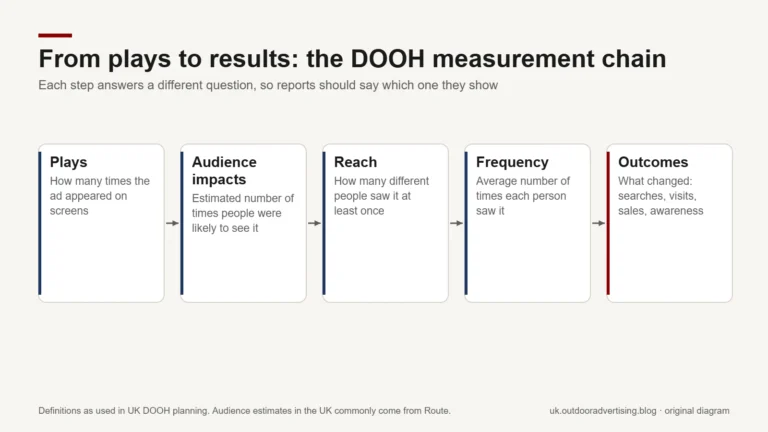
A technology brand creates a product testing experience in London. Selected digital screens help announce the activation. The brand measures: OOH delivery: Estimated impacts and relevant proof of play. Physical participation: Completed product trials. Business outcomes: Qualified enquiries and suitable follow-up responses.
Why Separation Matters
A person might see the digital billboard without visiting the activation. Someone may attend without having seen the billboard. The campaign should not automatically claim that every interaction was caused by OOH.
Integrated ROI
If the goal is to evaluate the combined campaign, the full relevant cost should include both the activation and the associated advertising. The incremental contribution should likewise be estimated for the integrated programme, without double-counting outcomes. Explore TRZY UK OOH and DOOH Advertising.
28. What Should Be Included in the Campaign Cost?
An ROI calculation is only useful if the expenditure is complete and consistently defined.
Possible Cost Categories
- Creative strategy
- Venue hire
- Fabrication
- Equipment
- Technology development
- Staffing
- Product stock
- Transport
- Installation
- Insurance and compliance
- Campaign management
- Content production
- Advertising amplification
- Reporting
- Relevant non-recoverable tax
- Other direct project expenses
VAT Considerations Whether
VAT belongs in the economic cost of the campaign depends on the advertiser’s circumstances, including input VAT recovery. A VAT-registered business may be able to recover eligible input VAT. The ROI calculation should use a clearly defined cost basis and avoid mixing recoverable VAT with genuine campaign expense.
Example
If two proposals have different VAT or accounting arrangements, compare them on a consistent economic basis. The campaign’s finance team should confirm the appropriate treatment.
29. A Full Experiential Marketing ROI Example
Consider a hypothetical UK brand activation involving product demonstrations. All figures are invented to illustrate the calculation.
Campaign Expenditure
| Item | Hypothetical cost |
|---|---|
| Venue | £4,000 |
| Production | £6,000 |
| Staffing | £3,000 |
| Logistics | £2,000 |
| Campaign management | £2,000 |
| Measurement | £1,000 |
| Other relevant costs | £2,000 |
| Total campaign cost | £20,000 |
Assume this cost is calculated consistently on an appropriate net economic basis.
- Observed
- Results 5,000 recorded visitors
- 2,000 completed demonstrations
- 300 valid enquiries
- 120 qualified leads
- 90 purchases observed within the follow-up window
Initial Efficiency Metrics
- Cost per completed demonstration: £20,000 ÷ 2,000 = £10
- Cost per qualified lead: £20,000 ÷ 120 = £166.67
Estimated Incremental Results
Suppose a credible evaluation estimates that 60 of the observed purchases were incremental. Assume contribution profit per incremental purchase is £450 before campaign expenditure. Incremental contribution: 60 × £450 = £27,000
ROI
ROI = [(£27,000 − £20,000) ÷ £20,000] × 100
ROI = 35%
What Should the Report Say?
Under the hypothetical assumptions, the campaign recorded 2,000 completed demonstrations, 120 qualified leads and an estimated 60 incremental purchases. The resulting estimated financial ROI is 35%. The methodology used to establish the 60 incremental purchases would need to be documented.
What Should the Report Avoid?
It should not claim that all 90 observed purchases were incremental. It should not treat the 300 enquiries as sales. It should not claim a 35% ROI without the supporting assumptions and evidence.
30. Evidence Quality: How Strong Are Your Conclusions?
Not all marketing measurements provide the same confidence.
| Measurement method | What it can support | Main limitation |
|---|---|---|
| Staff participation counts | Recorded activity | Counting accuracy and duplicates |
| QR codes | Tracked response Customer surveys | Misses untracked behaviour Reported awareness or recall Selection and recall bias |
| Before-and-after sales | Observed change | Other factors may explain it |
| Matched-market comparison | Stronger estimate of additional effect | Market comparability |
| Well-designed randomised | Stronger causal evidence study | May be expensive or impractical |
- Evidence
- Should
- Match the Claim
If a campaign only measures participation, it should report participation.
If it measures qualified enquiries, it can report those enquiries. If it has credible incremental sales evidence, it can estimate financial ROI. A polished report should not make stronger claims than its data supports.
31. When Is a Control Group Worth Using?
A control group can be useful when the financial decision is important enough to justify the research. Potential situations include:
- Large national sampling programmes
- Repeated retail activations
- Multi-city campaigns
- Significant automotive launches
- Major experiential investments
- Campaigns with reliable sales data
Control Market Example
A brand runs activations in selected stores while comparable stores operate without the activity. The business compares sales changes across the groups.
What Needs to Be Controlled?
- Promotions
- Stock availability
- Pricing
- Local demand
- Other advertising
- Store size
- Relevant historical trends
- When a Control
- Study
- May Not Be Practical
A single short pop-up with limited data may not support a meaningful control experiment. In such situations, the brand should report what it can measure and avoid unsupported causal claims.
32. A Practical Reporting Dashboard
A campaign report should be understandable to marketing, commercial and finance teams.
Suggested Report Sections
Campaign overview Objective, dates, locations, format and budget. Operational delivery Planned versus actual activation days and any material issues. Participation Verified visitors, interactions, trials and completions. Audience quality Relevant enquiries, qualification method and participant feedback. Commercial outcomes Appointments, purchases or opportunities where available. Attribution and incrementality Measurement method, assumptions and evidence strength. Financial evaluation Complete costs, incremental contribution and calculated ROI where supported. Recommendations What should continue, change or stop.
Example
- KPI
- Dashboard
| KPI | Hypothetical result | Interpretation |
|---|---|---|
| Campaign cost | £20,000 | Total expenditure |
| Verified visitors | 5,000 | Recorded visits |
| Completed demonstrations | 2,000 | Product trials |
| Demo cost | £10 | Cost efficiency |
| Qualified leads | 120 | Commercial interest |
| Cost per qualified lead | £166.67 | Lead efficiency |
| Estimated incremental | 60 purchases | Causal estimate subject to methodology |
| Incremental contribution | £27,000 | Financial value estimate |
| Estimated ROI | 35% | Based on contribution and cost assumptions |
The dashboard should include a short methodology note and definitions for every metric.
33. Data Collection and Privacy in UK Brand Activations
Some experiential campaigns collect personal information. Examples include:
- Names
- Email addresses
- Telephone numbers
- Appointment details
- Product preferences
- Survey responses
What Should Brands Consider?
The information should be collected for a defined purpose with a valid lawful basis.
Participants should receive appropriate privacy information.
Marketing Consent Providing an email address for an activation registration does not automatically mean the participant agrees to future promotional emails. For unsolicited electronic marketing to individual subscribers, consent is generally needed unless an applicable soft opt-in exception is satisfied.
Data Minimisation
If the objective is simply to count product trials, personal details may not be necessary.
Reporting Reports should use aggregated information where that meets the purpose. Collecting more personal data does not automatically improve the quality of the evaluation.
34. How to Measure ROI Without Collecting Personal Details
Some campaigns can be measured without identifying individual participants. Useful approaches may include:
- Aggregate interaction counters
- Product trial logs
- Anonymous surveys
- Aggregated sales comparison
- Venue-level reporting
- Non-identifying operational records
Example
A sampling campaign distributes 2,500 products and records anonymous feedback.
It may report sample delivery, selected preferences and cost per distributed sample.
What It Cannot Automatically Report
Without suitable sales or causal measurement, it cannot establish how many new customers the activation generated.
Why This Can Be Appropriate
Not every campaign needs personal data. A clearly defined awareness or product-trial objective may be evaluated using aggregate measures.
35. How to Avoid Inflated Experiential ROI Claims
Some reporting practices make campaigns appear more commercially successful than the evidence supports.
- Counting
- Venue
- Footfall as Participation
A person passing through a shopping centre is not necessarily an activation participant.
Counting Samples as Sales
A free sample is not a product purchase.
Counting Registrations as Qualified Leads
A registration may not indicate buying interest.
- Assigning
- All
- Campaign-Period
- Sales to the Activation
Other factors may influence those sales.
Confusing Revenue and Profit
Revenue must not be substituted for contribution profit in a profit-based ROI calculation.
Double-Counting Multichannel Results
A purchase should not be counted as incremental revenue from multiple channels without an appropriate evaluation framework.
- Applying
- Generic ROI
- Multipliers
There is no reliable universal multiplier that converts every experiential engagement into financial value.
Ignoring Missing Data
The report should explain what could not be measured. Accuracy is more useful than an impressive but unsupported percentage.
36. What Should Be Measured Before, During and After?
Before the Campaign Record:
- Business objective
- Target audience
- Primary KPI Budget Baseline data
- Planned tracking method
- Follow-up window
- Attribution approach
- Reporting responsibilities
During the Campaign Record:
Actual operating dates Staffing
- Verified participation
- Product trials
- Technical problems
- Stock consumption
- Relevant enquiries
- Consumer feedback
After the Campaign Review:
- Final expenditure
- Participant totals
- Qualified leads
- Relevant follow-up outcomes
- Sales where available
- Brand research
- Attribution evidence
- Incremental contribution
- Campaign lessons
Why This Sequence Matters
A measurement method designed after the campaign may not have the data required to answer the original question. For example, a before-and-after brand study cannot be completed reliably if no suitable baseline exists.
37. A 30-Day and 90-Day Follow-Up Plan
Not every experiential campaign has the same purchase cycle.
Immediately After the Activation
Review operational delivery and initial participation.
Around 30 Days
Where suitable, examine:
- Lead qualification
- Appointment completions
- Initial purchasing responses
- Relevant customer feedback
Around 90 Days
For products with longer consideration periods, review:
- Opportunity progression
- Relevant completed sales
- Repeat purchasing where appropriate
- Longer-term response
Important Qualification Thirty and ninety days are examples, not universal measurement windows. A consumer snack launch may have a short response period. An automotive or enterprise technology campaign may require a longer one. The follow-up schedule should reflect normal customer behaviour.
38. Campaign ROI Reporting Template
Use the following structure for a completed experiential campaign.
Campaign Information Brand: [Insert brand]
- Campaign name: [Insert name]
- Objective: [Insert primary objective]
- Locations: [Insert venues and cities]
- Campaign dates: [Insert dates]
- Target audience: [Insert audience]
- Investment Creative: £_____
- Venue: £_____
- Production: £_____
- Staffing: £_____
- Technology: £_____
- Logistics: £_____
- Management: £_____
- Measurement: £_____
- Other relevant costs: £_____
- Total campaign investment: £_____
- VAT and accounting treatment: [Explain]
- Participation Verified visitors: _____ Unique participants, if measurable: _____
- Completed demonstrations: _____
- Samples distributed: _____
Other recorded interactions: _____
- Commercial Outcomes Total enquiries: _____
- Qualified enquiries: _____
- Appointments: _____
- Observed purchases: _____ Estimated incremental purchases, if supported: _____
- Efficiency Cost per participant: £_____
- Cost per completed trial: £_____
- Cost per qualified lead: £_____
Financial Impact
Incremental contribution profit, if supported: £_____ ROI, if supported: _____%
Evidence and Limitations
- Data sources: [List]
- Attribution method: [Describe]
- Comparison group: [Describe, if used]
- Important assumptions: [List]
- Measurement limitations: [Explain]
- Recommendations Continue: [What worked]
- Improve: [What needs attention]
- Stop or reconsider: [What was not useful]
This format separates factual campaign delivery from estimated financial impact.
39. How TRZY UK Supports Experiential Marketing Measurement
A well-planned activation should have clear goals and a measurement approach before production begins. The most suitable KPIs depend on the product, intended audience and campaign objective. TRZY UK supports experiential marketing and brand activation campaigns across the United Kingdom. Relevant services include:
- Experiential campaign strategy
- Brand activations
- Product launches
- Retail experiences
- Interactive installations
- Automotive campaigns
- Entertainment marketing
- Creative production
- Campaign execution
- Measurement and reporting
Campaign planning can include defining practical participation measures, reporting requirements and relevant commercial outcomes. Where stronger attribution is required, the appropriate research approach should be agreed according to the campaign’s scale and available data. A simple activation may be evaluated using verified participation and qualified enquiries. A substantial multi-city programme may justify more detailed comparative analysis. Explore TRZY UK Experiential Activations and Brand Activation.
Frequently Asked Questions
What is experiential marketing ROI?
Experiential marketing ROI compares the incremental financial contribution generated by an experiential campaign with its total investment.
How do you calculate experiential marketing ROI?
Subtract the campaign cost from incremental contribution profit, divide by campaign cost and multiply by 100.
What is a good ROI for brand activation?
There is no reliable universal benchmark. A suitable return depends on the product, customer value, campaign objectives and quality of the evidence.
How do you measure experiential marketing success?
Measure outcomes linked to the objective, such as verified participation, product trials, qualified enquiries, brand lift or incremental sales.
What are the most important experiential marketing KPIs?
Common KPIs include completed interactions, product trials, cost per participant, qualified leads, awareness lift and credible financial outcomes.
What is cost per participant?
It is the total campaign cost divided by the number of verified participants.
Is cost per participant the same as customer acquisition cost?
No. Participation does not mean the person became a paying customer.
What is cost per qualified lead?
It is the relevant campaign expenditure divided by the number of enquiries meeting predefined qualification criteria.
Can product sampling generate measurable ROI?
Yes, if suitable sales and incrementality evidence is available. Sample distribution alone is insufficient to establish financial return.
How do you measure brand activation engagement?
Define meaningful actions, such as completed demonstrations, games or product trials, then record those actions consistently.
Can footfall be used as an activation KPI?
It can provide context, but total venue footfall should not be treated as actual participation.
What is brand lift?
Brand lift is a measured change in indicators such as brand awareness, recall or consideration.
How is brand lift calculated?
Absolute lift can be expressed as the difference between two percentages in percentage points. Relative lift compares that difference with the baseline.
What is incremental sales measurement?
It estimates additional sales caused by the campaign beyond what would have happened without it.
How can a control group help measure ROI?
An appropriate control group provides a comparison for estimating what might have happened without the campaign.
Is a before-and-after sales comparison enough?
It can show a change, but other influences may explain the result. Strong causal claims require stronger evidence.
Can QR codes track experiential marketing ROI?
QR codes can help record some campaign-associated responses but do not by themselves establish incremental profit.
Are social media views a useful KPI?
They may be relevant to content distribution, but they should not replace direct activation or commercial outcome measures.
How do you measure automotive activation performance?
Possible metrics include meaningful vehicle interactions, qualified test-drive enquiries, completed appointments and relevant sales outcomes.
How do you measure B2B experiential marketing?
Use qualified meetings, product demonstrations, sales opportunities and suitably measured commercial results.
Can film promotions measure experiential ROI?
They can track participation and appropriate audience outcomes. Attribution of ticket sales requires careful analysis.
What is the difference between ROI and ROAS?
ROI compares incremental contribution or profit with investment. ROAS compares revenue associated with advertising with advertising expenditure.
Why should contribution profit be used instead of revenue?
Revenue does not account for relevant product and service delivery costs. Profit-based ROI requires the appropriate contribution measure.
How long should experiential marketing results be tracked?
The evaluation window should reflect the normal product purchase cycle. Some campaigns need weeks while others need months.
Do you need personal data to measure activation performance?
Not always. Aggregate participation, anonymous surveys and suitably designed sales comparisons may support useful evaluation.
Can a brand collect email addresses at an activation?
Yes, subject to applicable privacy and electronic marketing rules. Registration for an experience does not automatically authorise future promotional emails.
How do you prevent inflated ROI reporting?
Define metrics clearly, avoid double-counting, use complete costs and distinguish observed results from incremental outcomes.
Should every activation report financial ROI?
No. If credible incremental profit data is unavailable, the report should provide appropriate marketing and operational KPIs without inventing ROI.
Can TRZY UK support experiential marketing measurement?
TRZY UK supports campaign planning, brand activations and performance reporting across the United Kingdom, with measurement requirements defined according to the project.
Conclusion
Experiential marketing ROI should not be judged only by how many people visit an installation, try a product or share photographs. Those activities can be valuable, but they measure different stages of campaign performance. A useful evaluation starts with the objective. For a sampling campaign, product trials may be the primary KPI. For an automotive launch, qualified enquiries and test-drive activity may matter more. For an awareness campaign, appropriate brand research may be necessary. Financial ROI requires an additional step: estimating the incremental profit that the campaign actually generated.
This is where attribution and incrementality become important. Brands should avoid treating every observed sale, enquiry or website visit as a direct result of the activation. Instead, campaign reporting should distinguish verified delivery, meaningful participation, commercial responses and credible estimates of additional business impact. The result is a more useful basis for future investment decisions. TRZY UK supports experiential marketing, brand activations, product launches and integrated promotional campaigns across the United Kingdom. To discuss an upcoming campaign, explore TRZY UK’s Experiential Activation Services or contact hello@trzy.co.uk.
Related guides
-
 Measurement & PerformanceHow to Measure DOOH: Reach, Impressions, Dwell Time and CPM
-
 Measurement & PerformanceHow to Measure an Outdoor Advertising Campaign in the UK
-
 Experiential & Brand ActivationExperiential Marketing vs Event Marketing: Key Differences