

Programmatic Digital Out-of-Home (prDOOH) advertising allows businesses to purchase eligible digital billboard and outdoor screen inventory through automated advertising technology. Instead of arranging every placement entirely through a traditional manual booking process, advertisers can use digital buying platforms to select suitable locations, set budgets, apply scheduling conditions and manage campaign delivery. Programmatic DOOH combines the physical presence of outdoor advertising with some of the flexibility associated with digital media buying. A retailer might advertise on selected shopping centre screens during relevant opening hours. An automotive brand could reach audiences across suitable roadside digital displays. A film distributor might schedule promotional messages around the weeks leading up to a theatrical release. However, programmatic DOOH does not mean every UK digital billboard is available for automated purchasing. It also does not guarantee that a screen will display an advertisement whenever the advertiser wants. Inventory access, creative approval, buying conditions and audience measurement still matter. This guide explains how programmatic DOOH works in the UK, how advertisers can buy screen inventory, what DSPs and SSPs do, how targeting and pricing work and how to plan and measure an effective campaign.
What Is Programmatic DOOH?
Programmatic DOOH is the automated buying and selling of eligible digital out-of-home advertising inventory. The advertising appears on physical digital screens in public and commercial environments rather than on someone’s personal phone or computer. Potential environments include:
- Digital roadside billboards
- Bus shelter screens
- Shopping centre displays
- Retail advertising screens
- Railway station advertising
- Selected transport environments
- Digital screens in leisure venues
- Certain large-format outdoor displays
The available inventory depends on the media owner and the buying platform. Programmatic systems allow an advertiser to define campaign requirements and access suitable screen opportunities through supported technology. For example, an advertiser might set a budget, identify relevant areas in London and Manchester, select permitted digital formats and establish when the campaign should run. The buying platform then attempts to purchase eligible advertising opportunities according to those settings and available deals.
What does “programmatic” mean?
In advertising, programmatic refers to technology-supported processes for buying and selling advertising inventory. It does not necessarily mean that every advertisement is purchased through a completely open auction.
Programmatic buying can include private marketplace arrangements, fixed commercial agreements and automated guaranteed deals. The exact options depend on the inventory and platform.
What does DOOH mean?
DOOH stands for Digital Out-of-Home. It refers to advertising displayed on electronic screens outside the home. All programmatic DOOH is digital out-of-home advertising, but not all DOOH advertising is purchased programmatically. Many digital screens are still sold through direct media-owner agreements.
Why Is Programmatic DOOH Growing in the UK?
Digital out-of-home advertising has become a significant part of the UK outdoor media market. According to IAB UK’s July 2026 industry report, UK DOOH advertising investment reached £964 million during 2025, representing 67% of total out-of-home advertising spending. The report forecasts that digital formats could account for 76% of total UK OOH spending by 2031. These figures describe the wider digital out-of-home market. They should not be interpreted as the value of programmatic DOOH alone. The distinction is important because a digital billboard may be purchased through traditional direct booking rather than an automated platform.
What is driving programmatic adoption?
Several developments are making programmatic buying more useful for advertisers. Access to digital inventory: Eligible digital screens can be connected to automated advertising systems. Audience-based planning: Buying decisions can use location and suitable aggregated audience information instead of focusing only on individual site names. Flexible campaign schedules: Advertisers may be able to purchase eligible opportunities during particular periods. Dynamic creative: Compatible screens can display approved messages based on contextual conditions. Integrated media planning: Programmatic DOOH can be considered alongside digital display, social media and other channels. Improved reporting: Platforms can provide delivery information and support audience-based measurement. However, measurement methods are not completely standardised across all operators. Advertisers should still check what each reported metric actually means.
How Does Programmatic DOOH Work?
A programmatic outdoor campaign involves several parts of the advertising technology supply chain. The process may appear complicated, but each participant has a specific role.
1. Advertiser
The advertiser is the business or organisation that wants to display its promotional message. It defines the audience, budget, campaign dates and desired results.
2. Media-buying team
The advertiser may work with an internal marketing team or an advertising agency. The team develops the campaign strategy, selects suitable formats and manages the buying process.
3. Demand-Side Platform (DSP)
A Demand-Side Platform, usually called a DSP, helps advertisers purchase eligible advertising opportunities.
The DSP can manage campaign settings such as budgets, schedules, buying conditions and selected inventory.
4. Supply-Side Platform (SSP)
A Supply-Side Platform, or SSP, helps media owners make eligible advertising inventory available to buyers. It communicates relevant advertising opportunities and commercial conditions to connected buying systems.
5. Media owner
The media owner controls or sells the advertising inventory. It may operate roadside billboards, transport screens, retail displays or other digital advertising networks. The media owner decides which inventory is available programmatically and what restrictions apply.
6. Digital screen and advertising player
The screen and its associated operating system display the approved campaign content. The system may record information about when an advertisement was played.
A simplified buying process
| Stage | What happens |
|---|---|
| Campaign setup | Advertiser defines budget, locations, dates and objective |
| Inventory selection | Suitable digital screens or deals are identified |
| Buying request | DSP receives an eligible opportunity through the connected supply system |
| Buying decision | The platform evaluates the opportunity against campaign settings |
| Transaction | An agreed buying mechanism determines whether the advertising opportunity is purchased |
| Creative delivery | Approved artwork is scheduled or supplied through the relevant system |
| Display | The advertisement appears on the selected screen |
| Reporting | The platform records delivery and applicable audience estimates |
Not every campaign follows exactly the same transaction process. Private marketplace and guaranteed buying arrangements can operate differently from open auctions.
DSP vs SSP: What Is the Difference?
The difference is straightforward. A DSP works primarily on the buying side. An SSP works primarily on the selling side.
| Feature | DSP | SSP |
|---|---|---|
| Main user | Advertisers and buyers | Media owners and publishers |
| Main purpose | Purchase advertising opportunities | Make inventory available for sale |
| Campaign budgets | Manages advertiser buying | Manages selling conditions settings |
| Inventory | Evaluates available opportunities | Supplies eligible screen opportunities |
| Pricing | Uses buying strategies and bids | May apply floor prices and deal rules |
| Reporting | Provides advertiser-facing delivery data | Supplies relevant media-owner records |
For an advertiser, the main concern is not the technical name of every system. It is whether the chosen buying arrangement provides suitable inventory, transparent pricing, approved creative delivery and reliable reporting.
What Are the Different Ways to Buy Programmatic DOOH?
Not every programmatic transaction is a fully open auction. Advertisers should understand the main buying arrangements before approving a campaign.
Open Auction
An open auction allows eligible buyers to compete for available advertising opportunities through supported systems. The media owner may apply restrictions, floor prices and other eligibility conditions. Potential advantage: Flexible access to available inventory. Consideration: The advertiser may not know in advance exactly which opportunities it will win. Open auction does not automatically mean access to every premium screen.
Private Marketplace (PMP)
A private marketplace provides access to a defined group of eligible buyers under specific deal arrangements. It may offer curated inventory, commercial conditions and targeting options. Potential advantage: Greater control over the available inventory and deal structure. Consideration: Access and delivery depend on the approved deal and available opportunities.
Preferred Deal
A preferred deal can provide negotiated commercial terms for selected inventory. The exact arrangement varies between platforms and media owners. It should not be assumed to guarantee every requested impression.
Programmatic Guaranteed
Programmatic guaranteed arrangements can use automation while agreeing specific inventory and delivery commitments in advance. The commercial details must be confirmed under the relevant agreement. Potential advantage: Greater certainty where guaranteed delivery is contractually available. Consideration: Booking terms may be less flexible than auction-based buying.
Which buying method should you choose?
| Requirement | Buying arrangement to investigate |
|---|---|
| Testing eligible screen opportunities | Open auction or suitable PMP |
| Accessing curated locations | PMP |
| Negotiating specific commercial terms | Preferred or private deal |
| Securing defined commitments | Programmatic guaranteed where offered |
| Buying premium inventory unavailable | Direct media-owner booking programmatically |
The right approach depends on the campaign objective and the inventory available.
What Is a Deal ID?
A Deal ID identifies a specific programmatic advertising arrangement within compatible buying systems. It helps the DSP recognise the inventory or commercial conditions associated with the deal.
For example, an advertiser may receive access to a curated group of digital screens chosen around relevant audience characteristics. The buying team can enter the approved Deal ID into a compatible DSP to activate the arrangement. However, a Deal ID is not a guarantee that the campaign will achieve its planned delivery. The advertiser must still confirm eligibility, budget, bids, creative approval and available opportunities.
What is a floor price?
A floor price is a minimum acceptable price set under a programmatic selling arrangement. For example, a media owner might make a deal available with a specified minimum CPM. The buyer may need to bid at or above the relevant floor. The actual amount paid depends on the buying rules and auction or deal structure. A published recommended CPM should not automatically be treated as a guaranteed clearing price.
How Does Programmatic DOOH Targeting Work?
Programmatic buying can help advertisers choose suitable locations and times using available audience and contextual information. However, it is important to understand what targeting means in a public-screen environment. Unlike an advertisement on a personal device, a digital billboard can be seen by several people at once. It generally does not display a different advertisement to every individual passing the screen. Instead, the system selects suitable advertising opportunities based on the campaign’s defined criteria.
Geographic Targeting
Advertisers can select eligible screens within relevant geographic areas. For example, a retailer might focus on shopping environments near its stores. An automotive brand might select suitable locations across several UK cities. Geographic targeting can be useful, but the actual screen locations should still be reviewed.
Audience-Based Planning Campaigns may use aggregated audience data to identify locations likely to reach relevant groups. For example, a buying team might assess locations associated with consumer interests or particular types of journeys. These audience characteristics are estimates rather than proof that every passer-by belongs to the intended group.
Time-of-Day Targeting
Some programmatic inventory supports advertising during selected hours. A brand might concentrate spending around relevant commuter or retail periods. This can be useful when the audience and message have a clear time relationship.
Day-of-Week Targeting
Advertisers may choose different campaign emphasis across weekdays and weekends. For example, a shopping-related campaign may be planned around relevant retail activity.
Weather-Based Targeting Compatible systems can use approved weather conditions as contextual triggers. A campaign might use one creative message during warmer weather and another during rainy conditions.
The advertiser must confirm which triggers are available and how reliably the system responds.
Event-Related Targeting
Some campaigns may be planned around scheduled entertainment or commercial events. However, access to relevant screen inventory and the necessary location permissions must still be confirmed.
- What Programmatic DOOH
- Cannot
- Guarantee
Programmatic targeting does not guarantee that every person who sees a screen matches the advertiser’s audience. It does not automatically provide individual-level tracking. It also does not guarantee that a campaign will win every eligible opportunity. Targeting improves the planning process, but the results remain dependent on the actual inventory and delivery.
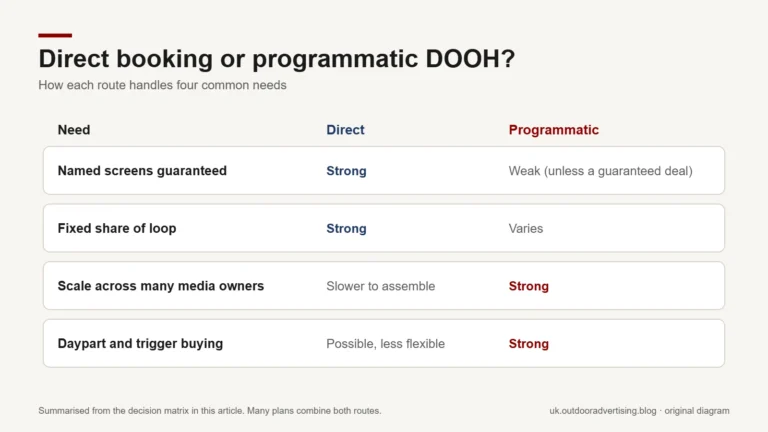
Programmatic DOOH vs Traditional DOOH Buying
Both methods can place advertising on digital screens. The main difference is how inventory is purchased and managed.
| Comparison | Programmatic DOOH | Direct DOOH buying |
|---|---|---|
| Buying process | Automated through supported platforms | Negotiated directly with media owners or through agencies |
| Inventory access | Eligible programmatically connected screens | Media inventory offered through direct booking |
| Scheduling | Can support flexible buying conditions | Depends on the agreed package |
| Pricing | Often CPM-based or deal-based | May use fixed rates, share of voice or other packages |
| Audience targeting | Can use available data and contextual rules | Uses location and relevant media planning data |
| Creative changes | Potentially flexible after required approvals | Depends on the media package |
| Delivery certainty | Depends on auction or deal type | Depends on contractual booking arrangements |
| Reporting | Platform logs and relevant audience estimates | Media-owner reporting and audience estimates |
Is programmatic always better?
No. A direct booking may be more appropriate when a brand needs a specific premium screen for a fixed campaign period. Programmatic buying may be useful when the advertiser values flexibility across several eligible screens. Some campaigns benefit from combining both methods. For example, a product launch might use a directly booked premium landmark screen alongside programmatic DOOH across selected regional locations.
How Much Does Programmatic DOOH Cost in the UK?
There is no universal fixed price for programmatic DOOH advertising in the UK. The total cost depends on the available inventory, audience requirements, buying arrangement, campaign dates, media quality and additional services. Programmatic campaigns commonly use CPM-based pricing, but the definition of the impressions being purchased must be understood.
What is CPM?
CPM means cost per thousand impressions. The basic calculation is:
Media cost = Estimated purchased impressions ÷ 1,000 × CPM For example, a campaign with an agreed CPM of £16 and 200,000 qualifying impressions would have a calculated media cost of: 200,000 ÷ 1,000 × £16 = £3,200. This is a mathematical illustration. Actual billing and measurement depend on the agreed definition of an impression, delivery records, applicable fees and buying rules.
A published UK programmatic pricing example A UK outdoor media owner’s publicly accessible programmatic deal hub lists a recommended CPM of £16 for several curated audience-based deals. These include example audience categories associated with family interests, entertainment, automotive and other consumer segments. However, £16 should not be presented as the average price of UK programmatic DOOH. It is a specific supplier’s published recommended level for selected deals. Other formats, screens and audiences may have different commercial conditions.
What affects the CPM?
| Pricing factor | Why it matters |
|---|---|
| Screen location | Premium or high-demand areas may have different rates |
| Format | Roadside, retail and transport screens have different commercial conditions |
| Audience requirements | Curated audience-based inventory may be priced differently |
| Buying method | Auction, private deal and guaranteed arrangements vary |
| Campaign timing | Particular periods may attract greater demand |
| Geographic reach | Available inventory differs between cities |
| Creative requirements | Format-specific production can add costs |
| Data and technology | Additional technology or audience services may carry fees |
| Measurement | Enhanced reporting and studies may add expenses |
| Management | Agency or specialist buying services may be charged separately |
Is there a minimum campaign budget?
Minimum spending requirements vary. Some platforms provide access to relatively small campaigns, while managed-service providers or media owners may apply larger minimum commitments. A platform’s technical minimum is not necessarily a recommended media budget. For example, an advertiser might technically be able to purchase a small number of impressions but still lack enough delivery to evaluate the campaign meaningfully. The appropriate testing budget should reflect the selected locations, duration, expected audience and reporting objectives.
Why a complete quotation matters
A quote may cover only the advertising media. Other elements could include creative production, technology fees, audience-data costs, campaign management and measurement. The final investment depends on the campaign requirements, quality expectations, locations, duration and total scope of work. A business should request a breakdown before committing to a campaign.
Example: A £10,000 Programmatic DOOH Test Campaign
Consider a hypothetical UK retailer planning a two-week digital outdoor advertising test across selected urban and retail environments. The retailer has a working budget of £10,000 before applicable taxes. The campaign’s main objective is to increase awareness around a new product launch. A possible budget structure could be:
| Budget component | Illustrative allocation |
|---|---|
| Media buying | £7,000 |
| Creative adaptation | £1,000 |
| Campaign setup and management | £1,200 |
| Measurement and reporting | £800 |
| Total | £10,000 |
These are hypothetical allocations, not published provider fees or a TRZY UK quotation. The media budget would be developed around actual screen inventory and agreed buying conditions.
How many impressions might the media budget purchase?
For illustration, assume an agreed CPM of £16. £7,000 ÷ £16 × 1,000 = 437,500 modelled billable impressions. That number is a calculation, not a guaranteed audience delivery forecast. Real performance would depend on the available inventory, applicable impression methodology, winning opportunities and actual campaign activity.
What would the campaign measure?
The team might examine delivered impressions, screen-level activity, selected geographic coverage and suitable brand-awareness indicators.
If the retailer has adequate data, it could also compare relevant business trends before and during the campaign. However, a change in sales should not automatically be attributed to the digital billboards.
What would make the campaign unsuccessful?
The campaign could underperform if the selected screens do not reach the intended audience, the creative is unclear or the budget is spread too thinly. A platform successfully spending the budget is not proof that the advertising strategy worked.
How to Measure Programmatic DOOH Advertising
Measurement is one of the most important parts of programmatic buying. However, advertisers must distinguish between technical screen delivery and human audience estimates.
What is a screen play?
A screen play occurs when a digital advertising player displays the creative. A proof-of-play record can help confirm when the advertisement appeared. However, one play does not necessarily represent one person seeing the advertisement. A single digital screen may be visible to several people at once. It may also play when fewer people are present.
What is an impression multiplier?
An impression multiplier is used in certain DOOH measurement systems to estimate the number of advertising impressions associated with a screen play. It may use information about expected audience presence, traffic patterns, dwell time and other relevant factors. For a simplified hypothetical example:
Screen plays: 100
Assumed audience multiplier: 80 impressions per play
Modelled impressions: 8,000
This is a demonstration of the calculation, not a real audience estimate. In practice, multipliers may vary by screen, time and measurement methodology.
What does ROUTE measure?
In Great Britain, ROUTE provides industry audience measurement estimates for out-of-home advertising. Its metrics include reach, cover, impacts, frequency and gross rating points. ROUTE emphasises that its viewed impacts are not directly equivalent to every impression measure reported by digital advertising systems. This distinction matters when comparing campaigns across platforms.
Reach and frequency
Reach estimates the number of different people who see a campaign. Frequency estimates how often those reached are expected to see it. A high impression total does not automatically mean that the campaign reached many unique people. Repeated exposure may account for part of the total.
Cost per thousand impacts
When suitable OOH audience data is available, advertisers can calculate cost per thousand estimated impacts. However, a CPM based on programmatic impressions should not automatically be compared with a CPM based on ROUTE impacts unless the underlying definitions are aligned.
What is a suitable campaign report?
A useful report should identify the delivery methodology rather than simply show a large impression number.
| Reporting element | What it should explain |
|---|---|
| Media spend | Amount spent on inventory |
| Screen delivery | Which inventory ran the campaign |
| Proof of play | Recorded advertising playback |
| Reported impressions | Measurement definition and methodology |
| Geographic coverage | Where activity was delivered |
| Timing | Dates and periods of delivery |
| CPM | Applicable cost and denominator |
| Reach and frequency | Where suitable estimates are available |
| Creative performance | Relevant differences between creative versions |
| Business outcomes | Agreed measures with appropriate limitations |
The goal is to understand whether the campaign delivered what was purchased and whether it supported the objective.
How to Use Dynamic Creative in Programmatic DOOH
Dynamic creative allows compatible screens and systems to select from approved creative versions according to defined conditions. This can make the message more relevant to the viewing context. However, dynamic creative should only be used when it contributes to the campaign.
Example
- 1:
- Weather-Responsive
- Advertising
A clothing retailer prepares two approved advertisements. One creative promotes suitable clothing for warmer conditions. Another promotes products intended for rainy weather.
The system uses an agreed weather trigger to select the appropriate version where supported. The advertiser must confirm the accuracy of the weather data, relevant creative rules and actual screen capabilities.
Example
- 2:
- Time-Based
- Food
- Promotion
A restaurant chain prepares different approved messages for suitable parts of the day. The campaign may emphasise breakfast during morning hours and another menu item during a later period. The actual locations, operating hours and advertised offers need to be accurate.
Example
- 3:
- Film Release Campaign
A film distributor prepares separate creative versions for different stages of the campaign. Before release: The campaign introduces the title and date. Opening week: The message confirms that the film is now showing at participating cinemas. After release: Approved content reinforces the release where still relevant. This can be useful if the campaign dates and distribution arrangements are confirmed.
Example
- 4:
- Automotive Campaign
An automotive brand prepares different approved messages for a vehicle launch. One highlights the announcement. Another explains a specific supported product feature. A third communicates where the product can be explored. The creative should not make unverified performance or availability claims.
Can dynamic creative run automatically without approval?
Not necessarily. Creative versions and the rules controlling them may require prior approval. Some media owners require every possible content variation to be checked. A system capable of changing creative instantly does not remove the need for technical and advertising compliance.
Which UK Cities Are Suitable for Programmatic DOOH?
A programmatic campaign can potentially include digital inventory across several UK cities, subject to the connected supply. Common markets worth investigating include London, Manchester, Birmingham, Leeds, Liverpool, Bristol, Glasgow, Edinburgh, Cardiff and Newcastle. However, it is not accurate to assume that every digital screen in those cities is available on every programmatic platform.
London London offers a broad range of roadside, street-level, transport, retail and commercial digital advertising environments. Different areas may be relevant for different target audiences. For example, an international entertainment campaign may consider suitable central London inventory, while a local retailer may focus on relevant neighbourhoods.
Manchester Programmatic buying may be considered for available retail, roadside and other digital environments. The screen selection should reflect the actual audience and geographic objective.
Birmingham A brand planning a Midlands campaign could investigate eligible screens in relevant commercial and retail locations.
Leeds and Liverpool
These markets may support regional campaigns where connected inventory is available. The advertiser should assess the actual screens rather than purchasing inventory based only on city names.
Glasgow and Edinburgh
Brands seeking relevant Scottish audiences can investigate available digital outdoor inventory across suitable environments.
Multi-City Buying Programmatic buying may simplify the management of eligible inventory across several cities. However, a campaign should not spread its budget across too many disconnected locations. The plan should still prioritise audience relevance and meaningful delivery.
Programmatic DOOH for Different Industries
Different industries can use programmatic buying for different purposes.
| Industry | Potential campaign approach | Key consideration |
|---|---|---|
| Retail | Suitable shopping and street-level digital screens | Proximity to relevant customers |
| FMCG | Retail and consumer-oriented digital inventory | Product relevance and content restrictions |
| Automotive | Selected roadside and commercial screens | Audience fit and accurate product claims |
| Real estate | Digital inventory around relevant geographic markets Potential campaign | Local audience and project availability |
| Film and streaming | Entertainment-related locations and staged creative | Release timing and platform availability |
| Technology | Commercial and selected | Clear product explanation consumer environments |
| Recruitment | Relevant commuter and business environments | Suitable audience and opportunity details |
| Tourism | Eligible transport and visitor-related screens | Relevant travellers and destinations |
| Events | Suitable locations and time-based messaging | Accurate event dates and venue information |
The most suitable format depends on the campaign objective. Programmatic capabilities should be selected because they add value to the campaign, not simply because the technology is available.
- How Programmatic DOOH
- Fits Into a Wider
- Marketing Campaign
- Programmatic
DOOH can work alongside search advertising, social media, online video and other promotional channels. However, combining channels should have a clear purpose. For example, outdoor screens can build awareness of a new product in selected physical environments. Online content may provide additional product information. A relevant search campaign may help people who subsequently look for the brand. A launch event or brand activation may give audiences an opportunity to interact directly with the product.
Example: A Coordinated Product Launch
Consider a hypothetical consumer technology company launching a product in London and Manchester. The marketing plan could include: Programmatic DOOH: Eligible digital screens in relevant commercial and retail locations. Online video: Product demonstrations and approved launch creative. Search advertising: Relevant campaigns for people researching the product. Brand activation: A suitable live demonstration at an approved venue. Each channel has a different role. A well-designed campaign connects the messaging without assuming every person will encounter every channel.
Should all campaigns use multiple channels?
No. A smaller campaign may benefit from a focused media plan. It is better to use a limited number of relevant channels effectively than to spread the budget across too many activities without sufficient reach. For integrated campaign requirements, brands can explore TRZY UK’s outdoor advertising and DOOH services.
Privacy and Data Protection in Programmatic DOOH
Programmatic advertising may use different types of audience and contextual data. Advertisers should understand which data is being used and whether the supplier’s processing is appropriate.
Does Programmatic DOOH Track Individual Passers-By?
Not inherently. A public digital billboard can display an advertisement based on a location or scheduled condition without identifying individual viewers.
However, some audience planning and measurement services may use information derived from personal devices or other data sources. If personal information is processed, the relevant UK privacy rules apply.
UK GDPR Organisations processing personal data must identify an appropriate lawful basis and meet relevant transparency and data protection requirements. The appropriate basis depends on the actual processing. Legitimate interests may be available in certain circumstances, but it is not automatically suitable.
PECR The Privacy and Electronic Communications
Regulations can apply to technologies used to store or access information on personal devices. Consent requirements may arise in relevant advertising and tracking arrangements. Advertisers should not assume that a public-screen campaign automatically avoids all privacy responsibilities.
Questions to Ask
- Data
- Providers
Before using third-party audience data, ask:
What information is collected?
Is it personal, aggregated or anonymised? Where did it come from? What permissions or lawful basis support its use? How long is it retained? Is it shared with other organisations? Can the campaign achieve the objective using less intrusive data?
Contextual targeting based on suitable locations, times and conditions may be sufficient for many campaigns without unnecessary personal-data processing.
Advertising Standards and Creative Approval in the UK
Programmatic buying does not remove advertising compliance responsibilities. The campaign creative must follow applicable UK advertising rules. The CAP Code applies to relevant non-broadcast advertising and contains requirements covering misleading claims, harm, offence, social responsibility and particular product categories.
Accurate Product Claims
Advertising statements should be supported by appropriate evidence. For example, a vehicle advertisement should not include unverified performance or environmental claims.
Price and Promotional Claims
Offers must be accurate and presented clearly. Dynamic creative should not continue displaying a promotional price after the offer expires.
Restricted Products
Some products and services face additional advertising restrictions. The selected media operator may also impose location-specific rules.
Roadside Digital Screens
Some roadside digital screens restrict animation or rapid visual changes. Advertisers must check the selected screen’s technical and safety requirements.
Creative Approval
Each creative version may need to be reviewed before campaign delivery. Advertisers should allow sufficient lead time for technical checks and approval.
The ability to purchase an advertising opportunity through automation does not mean unapproved artwork can be displayed immediately.
Common Programmatic DOOH Mistakes
Assuming Every Screen Is Available Programmatically
Programmatic inventory is limited to participating and compatible screens. Some premium placements may require direct booking.
- Confusing
- Screen Plays With Human
- Impressions
One play may be viewed by several people or no one. The impression methodology needs to be understood.
- Treating CPM as the Only
- Success
- Metric
A lower CPM does not guarantee a more relevant audience. Location and campaign objectives remain important.
- Using
- Excessively
- Narrow
- Targeting
Too many restrictions can reduce eligible opportunities and prevent the campaign from delivering its intended budget.
- Assuming
- Audience Data
- Identifies
- Individuals
- Many
DOOH audience estimates describe groups or locations rather than specific identified viewers.
- Ignoring
- Media Owner
- Restrictions
Not every digital screen allows animation, dynamic creative or all product categories.
Failing to Approve Creative Variations
Dynamic advertisements must still comply with the agreed technical and content rules.
- Spending
- Too
- Little to Evaluate the Campaign
A very small media test may deliver too few qualifying impressions to provide useful results. Testing requirements should be planned before the budget is approved.
- Comparing
- Different
- Impression
- Definitions
Platform-reported impressions, screen plays and ROUTE impacts are not necessarily equivalent. The measurement basis must be clear.
- Assuming
- Programmatic
- Automatically
- Improves ROI
Automation can improve buying flexibility, but it does not guarantee sales, awareness or other commercial outcomes.
How to Plan a Programmatic DOOH Campaign
The following process can be used as a practical buying checklist.
Step 1: Define the Objective
Identify whether the campaign is intended to build awareness, support a launch or reach a defined geographic audience.
Step 2: Describe the Audience
Specify the relevant customer groups and locations. Avoid relying on demographic assumptions without supporting data.
Step 3: Select the Geographic Scope
Choose the UK cities, regions or suitable venue environments.
Step 4: Check Eligible Inventory
Confirm which screens and formats are available through the selected buying arrangement.
Step 5: Choose the Buying Method
Decide whether an open auction, private marketplace, preferred deal or guaranteed arrangement is appropriate.
Step 6: Agree the Budget
Establish the complete investment, including media and additional services.
Step 7: Prepare the Creative
Develop approved artwork for the selected screen specifications.
Step 8: Configure Campaign Conditions
Set the agreed dates, schedules, targeting and deal requirements.
Step 9: Complete Quality Checks
Verify the available inventory, creative approval and reporting setup.
Step 10: Launch and Monitor
Monitor actual delivery and investigate material differences from the planned activity.
Step 11: Optimise Carefully
Adjust eligible inventory or scheduling when the available data provides a reasonable basis for doing so. Avoid making constant changes that prevent meaningful evaluation.
Step 12: Report the Results
Compare actual campaign delivery with the objective, budget and agreed measurement methodology. The report should clearly distinguish technical delivery from estimated audience exposure and commercial outcomes.
Programmatic DOOH Campaign Brief Template
Before requesting a proposal, prepare the following information.
| Information | What to provide |
|---|---|
| Brand | Company or product name |
| Objective | Awareness, launch, consideration or another goal |
| Audience | Relevant customer characteristics |
| Geography | Preferred cities, regions or environments |
| Inventory | Roadside, retail, transport or open to recommendations |
| Dates | Start date and duration |
| Budget | Working media and production budget |
| Buying method | Open auction, PMP or open to advice |
| Targeting | Relevant contextual or audience requirements |
| Creative | Existing digital assets or production needs |
| Dynamic content | Whether multiple approved versions are required |
| Measurement | Required delivery and audience metrics |
| Compliance | Applicable product, content or location restrictions |
A clear brief helps the buyer assess which programmatic capabilities are actually needed.
Frequently Asked Questions
- About
- Programmatic DOOH What is programmatic
- DOOH in simple terms?
Programmatic DOOH is the automated buying of eligible digital billboard and outdoor screen advertising inventory through advertising technology.
How is programmatic DOOH different from traditional digital billboard advertising?
Traditional digital billboard advertising may be booked directly through a media owner. Programmatic buying uses connected technology to purchase eligible opportunities through auctions or other automated deal structures.
Is all digital outdoor advertising programmatic?
No. Many UK digital screens are sold through direct agreements. Only inventory connected and made available through suitable programmatic systems can be purchased that way.
What is a DSP?
A demand-side platform is a buying system that helps advertisers manage and purchase eligible advertising opportunities.
What is an SSP?
A supply-side platform helps media owners make eligible advertising inventory available to buyers.
What is a private marketplace?
A private marketplace is a controlled programmatic buying arrangement that provides access to defined inventory under specified conditions.
How much does programmatic DOOH cost in the UK?
Pricing varies by screen, location, audience, buying arrangement and campaign requirements. Some public UK programmatic deals publish recommended CPMs, but those figures should not be treated as universal market rates.
Is programmatic DOOH suitable for small businesses?
It can be, depending on the inventory, minimum spending requirements and campaign objective. A smaller business should ensure its budget provides enough relevant delivery to justify the investment.
Can programmatic DOOH run only at particular times?
Some inventory supports time-based scheduling. Availability depends on the screen network and buying system.
Can weather trigger billboard advertisements?
Compatible systems may support approved weather-based creative or scheduling conditions. The campaign needs the necessary creative, data source and technical configuration.
Can digital billboards show video?
Some can, but not all. Technical specifications and content restrictions vary between screens.
Does programmatic DOOH use cookies?
The public-screen display itself does not require a cookie on a viewer’s device. However, some connected audience and measurement services may involve data-processing technologies that require separate privacy assessment.
What is the difference between a screen play and an impression?
A screen play records that an advertisement appeared on a digital display. An impression is a measurement concept that may estimate relevant audience exposure. The exact definition depends on the methodology used.
Can programmatic DOOH be used for film promotion?
Yes. Eligible digital screens can support entertainment campaigns, including release-date advertising and other approved promotional messages.
- Can international brands buy
- UK programmatic
- DOOH?
Yes. International advertisers can plan suitable UK campaigns through available buying and execution arrangements, subject to inventory access, content approval and applicable requirements.
Does programmatic DOOH guarantee campaign performance?
No. Automated buying can provide flexibility, but awareness, audience response and commercial performance depend on the campaign strategy and actual delivery.
Final Thoughts: Use Programmatic Technology to Make Better Media Decisions Programmatic
DOOH has expanded the ways advertisers can access digital outdoor advertising in the United Kingdom. It allows eligible inventory to be purchased through technology-supported arrangements and can offer additional flexibility for location selection, scheduling and creative delivery. However, the fundamental principles of outdoor advertising remain important. A campaign still needs a relevant audience, suitable locations, clear creative and a realistic budget. Programmatic buying should help improve those decisions rather than replace them. The most important consideration is not how many screens a buying platform can access. It is whether the selected advertising opportunities reach the intended audience and support the campaign’s objective within the agreed budget. Advertisers should also understand the difference between screen delivery records, estimated impressions and actual business outcomes. A transparent proposal should explain the buying method, pricing, available inventory, measurement approach and complete cost.
Planning Programmatic DOOH Advertising in the UK?
TRZY UK provides outdoor advertising and digital out-of-home campaign services for UK and international brands. Businesses can explore TRZY UK’s OOH and DOOH advertising services when planning suitable digital screen campaigns, creative production and wider advertising activity. Programmatic buying options and inventory availability should be confirmed as part of the campaign brief. The final quotation depends on the chosen locations, buying arrangements, creative requirements and agreed scope. UK contact Email: hello@trzy.co.uk Phone: +44 7774 676763 India contact Email: marketing@trzy.in Phone: +91 9717059636 Editorial disclosure: This article includes links to TRZY UK services. Industry figures, programme examples and indicative CPM information are provided for educational purposes. Hypothetical budgets and calculations are not supplier quotations or guaranteed performance forecasts. Programmatic inventory and buying options must be confirmed before booking.
Related guides
-
 DOOH & Creative TechnologyProgrammatic DOOH vs Direct Screen Booking: Which Makes Sense?
-
 DOOH & Creative TechnologyInteractive DOOH Campaign Ideas for UK Retail and Entertainment
-
 DOOH & Creative TechnologyWhat Is Share of Loop in DOOH Advertising?