

When comparing outdoor advertising options, one of the first figures advertisers encounter is the number of impressions a billboard or digital screen is expected to deliver. A media proposal might estimate 500,000 impressions for a local campaign or several million for a wider advertising schedule. But what do those numbers actually mean? Do they represent different people? Are they calculated from traffic passing the billboard? Does every digital screen play count as an impression? And how can an advertiser know whether the figures in a quotation are realistic? These questions matter because outdoor advertising does not work in the same way as most online advertising. A website can record when an advertisement is served. A digital billboard is visible to a changing public audience, and one display of an advertisement may be seen by several people. Equally, not everyone passing a billboard will notice it. In Great Britain, the out-of-home advertising industry uses Route audience measurement to estimate how many people are likely to see outdoor advertising. Route combines information about people’s journeys, audience volumes, advertising locations and visual attention to produce estimates for static posters and digital screens. The resulting figures can help advertisers compare media plans.
However, they are estimates based on research and modelling. They are not direct counts of every individual who looked at a particular advertisement. This guide explains OOH impressions and Route audience data in the UK, including the difference between impressions, impacts, reach, frequency, traffic counts and digital screen plays. It also explains how these figures are calculated, why they change with the advertising schedule, how uncertainty should be understood and what to ask before approving a billboard quotation.
1. What Are OOH Impressions?
OOH stands for out-of-home advertising. It includes advertising displayed in public and commercial environments such as roads, transport networks, shopping destinations and city centres. An OOH impression generally refers to an occasion on which an advertisement is seen or exposed to an audience, depending on the measurement system being used. However, different organisations use the word impression differently.
The UK Industry Distinction In Great Britain, Route uses the term impacts for the estimated total number of occasions on which an OOH advertisement or campaign is seen. Route’s impacts account for the likelihood of seeing advertising rather than simply counting people who pass a screen.
- Why Advertisers
- See
- Different
- Words
A media proposal may use:
- OOH impressions
- Audience impacts
- Viewed impressions
- Estimated contacts
- Digital screen impressions
Screen plays
These terms are not necessarily interchangeable.
Practical Recommendation
When a quotation mentions impressions, ask: “Are these Route audience impacts, recorded ad plays, traffic counts or another measurement?” The answer determines how the figure should be interpreted.
2. What Is Route Audience Measurement?
Route is the joint industry audience measurement currency for out-of-home advertising in Great Britain. It provides audience estimates for static posters and digital screens. Route’s research and modelling help estimate:
- Who is likely to see an advertisement
- How many different people a campaign may reach
- How often those people may encounter the campaign
- How audience characteristics vary by advertising location
- How the proposed schedule affects the audience estimate
What Does ‘Industry Currency’ Mean?
An industry currency is an agreed measurement framework used to support planning and buying decisions. It helps advertisers evaluate outdoor advertising opportunities using consistent definitions.
Why Route Matters
Without a shared framework, one media owner might quote the total number of people passing a location while another quotes a visibility-adjusted audience.
The two figures would appear comparable even though they describe different things.
Important Geographic Limitation
Route’s published audience currency covers Great Britain, with a population framework based on people aged 15 and over. Advertisers should not automatically assume that the same figures provide complete measurement coverage for Northern Ireland or younger children.
3. Why Billboard Impressions Cannot Be Counted Like Online Ads
Online and outdoor advertising have different delivery environments.
Online Advertising
A platform may record when an advertising impression is served or rendered according to its system’s definition. The impression is connected to a digital advertising event.
Outdoor Advertising
An advertisement can be visible to several people at once. A single digital screen play might be seen by multiple people. Another play might occur when very few people are looking at the screen.
Example
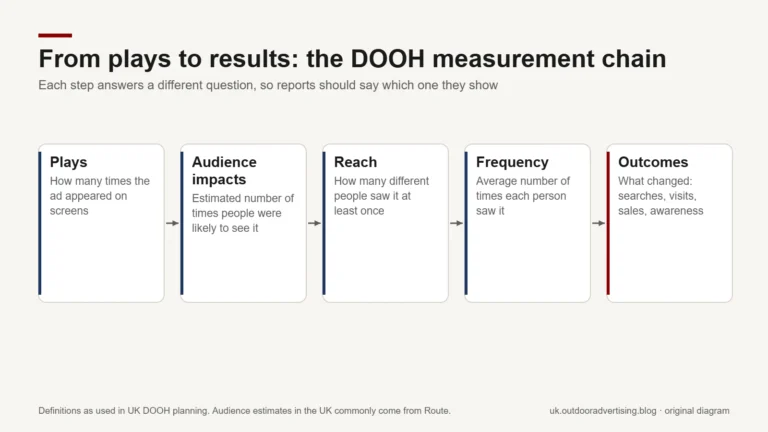
Imagine a digital billboard displays a car advertisement 1,000 times during a day. Those are 1,000 recorded plays, assuming the playback records are reliable. They are not automatically 1,000 audience impacts.
Why?
Some plays may occur during busy periods. Others may occur during quieter periods.
The number of people able to see the screen and the likelihood of noticing the advertisement vary.
Main Principle
The advertising delivery count and the estimated viewing audience are separate measures.
4. What Is an OOH Impact?
An OOH impact is an estimated occasion on which an advertisement is seen by a person under the relevant audience measurement model. One person may contribute multiple impacts.
Example
A campaign reaches an estimated 100,000 different people. Each reached person sees the campaign an average of four times. Estimated impacts: 100,000 × 4 = 400,000 impacts.
What Does 400,000 Mean?
It represents the estimated total viewing occasions.
What It Does Not Mean
It does not mean:
- 400,000 unique people
- 400,000 purchases
- 400,000 website visits
- 400,000 guaranteed viewers individually verified by a camera
Why This Matters
A campaign with many repeated exposures can produce a high impact total without reaching the same number of different individuals.
5. The Difference Between Reach and Impacts
Reach and impacts answer different questions.
Reach How many different people are estimated to see the campaign?
Impacts How many total viewing occasions are estimated?
Comparison
| Metric | What it represents | Can one person count multiple times? |
|---|---|---|
| Reach | Different people estimated | No, within the defined period to see the campaign |
| Impacts | Total estimated viewing occasions | Yes |
| Frequency | Average viewing occasions per reached person | Not a headcount |
Example
- Campaign
- A:
Reach: 200,000 Impacts: 600,000
Campaign B:
Reach: 350,000 Impacts: 700,000
Campaign B reaches more different people. Campaign A has a higher average frequency.
Which Campaign Is Better?
The answer depends on the objective. A new product launch may benefit from reaching a wider audience. A geographically focused campaign may value repeated opportunities to see the advertisement. However, frequency alone does not establish that a particular message was remembered or acted upon.
6. What Is OOH Frequency?
Frequency is the average number of times reached people are estimated to see the campaign.
Formula
- Frequency = Impacts ÷ Reach
- Worked Example Estimated impacts: 900,000
- Estimated reach: 300,000
- Frequency: 900,000 ÷ 300,000 = 3.
Interpretation The reached audience sees the campaign an estimated average of three times.
Important Detail Average frequency does not mean every person sees the campaign exactly three times. Some may encounter it once. Others may encounter it more often.
Why This Matters for Media Planning
A campaign concentrated around commuter routes may generate repeated exposure among regular travellers. A campaign distributed across more locations may reach a wider range of people. The right balance should reflect the advertising objective and target audience.
7. What Is Audience Cover?
Cover expresses the proportion of a defined target population reached by an OOH campaign.
Formula
Cover (%) = Reach ÷ Target population × 100
Example
A campaign is planned against a target population of 600,000 people. Its estimated reach is 150,000. Cover: 150,000 ÷ 600,000 × 100 = 25%.
What Does This Mean?
Approximately one quarter of the defined target population is estimated to see the campaign at least once.
- Why the Audience
- Definition
- Matters
Twenty-five per cent cover of one local audience is not the same as twenty-five per cent cover of all adults in Great Britain.
- Before
- Comparing
- Cover
- Figures
- Check:
- Geographic market
- Audience definition
- Age range
- Campaign period
- Route release
- Media schedule
Cover is only meaningful when its denominator is clear.
8. What Are Gross Rating Points?
Gross Rating Points, commonly called GRPs, combine audience cover and average frequency.
Formula
- GRPs = Cover (%) × Frequency
Example
- Cover: 25%
- Frequency: 4
- GRPs:
25 × 4 = 100 GRPs.
Why Can GRPs Exceed 100?
GRPs include repeated viewing occasions. They are not a percentage of unique people.
Another Example
A campaign reaches 50% of a target population with an average frequency of three. GRPs: 50 × 3 = 150 GRPs.
- What GRPs
- Help
- Compare
They are useful for comparing gross audience delivery against a defined target population.
What GRPs Do Not Establish
They do not directly measure:
- Sales
- Brand awareness
- Customer enquiries
- Advertising recall
- Financial return
GRPs are an audience planning metric.
9. How Does Route Estimate Outdoor Audiences?
Route does not simply install a camera at every billboard and count everyone looking at it. Its system combines multiple sources of research and information.
- Main
- Inputs
- Travel and movement research
- Volumes of people using roads and public spaces
- Advertising frame locations
- Advertising format characteristics
- Viewer position and movement
- Eye-tracking research
- Audience information
The Simplified Process
People’s travel patterns → Opportunities to encounter advertising → Visibility and attention adjustment → Modelled audience estimates
- Why Several
- Data
- Sources Are Needed
A traffic count can indicate how busy a road is. It does not fully explain who is travelling there or whether an individual notices a particular billboard. Likewise, knowing the billboard’s dimensions is not enough to estimate its audience.
Route’s Approach By combining different types of evidence, Route estimates which individuals are likely to see the advertising and how frequently they may encounter it.
Important Qualification
The final result is a modelled estimate. It should not be represented as a directly observed count of every viewing event.
10. How Route Uses Travel Research
Understanding how people move is central to OOH audience measurement.
Why Movement Matters
People encounter outdoor advertising while:
- Walking
- Driving
- Travelling by public transport
- Shopping
- Visiting commercial destinations
- Moving through other environments
Research Method Route describes a hybrid travel survey approach involving participants who agree to have their journeys recorded using tracking technology.
The travel information is combined with other research and modelling.
What This Helps Estimate
- Journey patterns
- Relevant travel environments
- Repeated travel
- Geographic audience movement
- Opportunities to encounter advertising
Important Distinction
A research sample is not the entire population of Great Britain. The measurements need appropriate analysis and modelling to produce population-level estimates.
Why It Matters for Advertisers
The audience figure is not simply a raw total of observed research participants. It is an estimate developed from a wider measurement framework.
11. Traffic Counts vs Billboard Audience Estimates
Traffic volumes can be useful inputs, but they should not be confused with billboard impacts.
Road Traffic
A count may record vehicles passing a location.
Pedestrian Activity
A count may record people moving through an area.
Venue Footfall
A count may describe visits to a shopping centre or other destination.
OOH Audience
An audience estimate considers the relevant advertising location and likelihood of people seeing the advertisement.
Example
A road carries 40,000 vehicles per day. That does not mean a billboard beside the road produces exactly 40,000 daily impacts.
Why Not?
Possible differences include:
- Number of people in vehicles
- Travel direction
- Viewing angle
- Screen visibility
- Journey speed
- Obstructions Repeated journeys
- Whether the advertisement is actually displayed when people pass
Practical Principle Never convert daily traffic into estimated OOH impacts using an arbitrary assumption. Use an appropriate audience measurement method.
12. Why Visibility Matters
Two billboards along the same road can have different audiences.
Factors to Consider Screen size
- Height
- Viewing angle
- Distance from the audience
- Direction of travel
- Speed of movement
- Visibility obstructions
- Illumination
- Advertising format
Example Billboard
A faces oncoming traffic. Billboard B is positioned at an angle that may be less visible to the same traffic. Even if the road’s vehicle count is identical, the advertisements may have different likely-to-see audiences.
- Why Screen
- Size Is Not
- Everything
A larger billboard may provide greater visibility from a distance. However, a smaller screen positioned in a suitable pedestrian environment may also reach a valuable audience.
Important Point
A high-quality OOH plan should consider the screen’s viewing context rather than selecting inventory solely by physical dimensions.
13. What Does ‘Likely to See’ Mean?
Route uses a visibility-adjusted approach to estimate people likely to see advertising. This goes beyond simply identifying everyone who passes near a poster.
Opportunity to See
A person travels through a location where an advertisement could potentially be visible.
Likelihood to See
The measurement model assesses how likely the person is to notice the advertisement, using visibility and attention research.
Why the Difference Matters
Not everyone passing a billboard looks at it. Likewise, some people may have several opportunities to see the same advertisement.
Important Qualification Likely to see is a statistical measurement concept. It does not mean the system has directly verified the attention of every individual in the campaign audience.
Practical Recommendation
Use language such as: “Estimated impacts based on Route’s likely-to-see audience methodology.” Avoid: “Every impact represents a named person who definitely looked at the advert.”
14. What Is Eye-Tracking Research?
Eye tracking is research used to investigate where people look. Within the Route methodology, eye-tracking findings help inform the relationship between advertising visibility and the likelihood of noticing a display.
- Why Eye
- Tracking
- Helps
It can provide information about how attention varies with factors such as:
Viewing angle
- Distance
- Advertising size
- Travel conditions
- Exposure opportunities
Important Distinction Eye-tracking research informs the model. It does not mean every person on a motorway is having their eye movements tracked individually during a campaign.
Example
A study may help estimate how visibility changes as someone approaches a roadside advertisement. Those findings can inform a wider modelling process.
Why This Is Important
Audience estimates based on visual attention have a different meaning from raw counts of people passing a location.
15. How Does Route Measure Static OOH?
Static OOH displays printed advertising for an agreed period. Examples include:
- Six-sheet posters
- Bus shelter posters
- Large roadside billboards
- Printed transport displays
Audience Measurement
The estimate considers the location, audience movement and relevant visibility factors.
- Why Display
- Dates
- Matter
A poster booked for one week has a different campaign period from a poster booked for four weeks.
What If the Poster Is Not Installed?
An audience estimate for a planned site does not establish that the advertisement was actually displayed.
Delivery Evidence Media-owner posting records and suitable installation evidence help verify delivery.
Main Principle Audience estimates and proof of posting are separate requirements. One estimates who may see the advertising. The other helps establish whether the creative was installed.
16. How Does Route Measure Digital OOH?
Digital outdoor screens display advertising content according to a schedule. A screen may show several advertisers during a rotation.
Why Digital Measurement Is Different
The advertiser’s creative is not necessarily visible every time somebody passes the screen. The schedule affects the audience estimate.
- Important
- Inputs
- Screen location
- Audience movement
- Visibility
- Advertising duration
- Relevant display schedule
- Time between appearances
- Campaign period
Example
A screen may display a ten-second advertisement within a longer rotation. The audience opportunity differs from an advertisement displayed continuously.
Why This Matters
A quotation should not use a continuous-display audience figure as though it automatically represents an intermittent booking.
Practical Recommendation
Ask for an audience estimate based on the exact proposed schedule.
17. What Is a DOOH Spot?
A spot is an instance of an advertisement appearing on a digital screen for a specified duration.
Example
An advertiser books a ten-second creative. The screen plays that creative during its advertising rotation.
Spot Duration
This describes how long the creative remains on screen for each appearance.
Break or Rotation
This describes the time between appearances under a specified schedule.
Example
Schedule Ten seconds of advertising followed by fifty seconds before the next appearance.
This is often represented as: 10s:50s
Why This Matters
The campaign’s visibility opportunities depend partly on how the creative is scheduled.
Important Point
A ten-second creative is not necessarily the same as ten seconds of continuous advertising every minute throughout every operating hour. The booking details must be confirmed.
18. Why Spot Schedules Change DOOH Impacts
The frequency with which a creative appears affects estimated viewing occasions.
Continuous Display
A screen showing the same advertisement continuously creates different opportunities from a screen sharing time between multiple advertisers.
Rotating Display
A creative may appear at intervals. Potential viewers may pass while another advertisement is showing.
- Route’s 2026
- Data
- Example
Route’s public Q3 2026 audience summary uses a 10-second spot with a zero-second break assumption for its headline digital impacts. This means the headline assumption represents continuous display.
Why This Must Be Checked
Many real digital advertising bookings involve shared screen time. The audience estimate therefore needs to reflect the actual scheduled share.
Important Warning Do not simply multiply or divide headline Route figures by a guessed share-of-time percentage and present the result as an official Route calculation. The audience model and campaign schedule need to be evaluated correctly.
19. A Simple DOOH Screen Play Calculation
Screen plays can be calculated from a schedule, but they are not the same as audience impacts.
Hypothetical Schedule
An advertisement runs:
- Ten seconds per appearance
- Once every two minutes
- Twenty-four hours per day
- Seven days
Theoretical Plays per Day There are 1,440 minutes in a day. 1,440 ÷ 2 = 720 scheduled plays per day.
Theoretical Plays per Week
720 × 7 = 5,040 scheduled plays.
What Does This Number Represent?
It represents a theoretical playback schedule.
What Does It Not Represent?
It does not represent:
- 5,040 unique viewers
- 5,040
- Route impacts
Confirmed actual playback Measured consumer attention
Why Actual Delivery May Differ
Screens may have different operating hours, technical interruptions or scheduling restrictions. Actual playback requires verification.
Key Lesson
A play count cannot be converted into an audience estimate without the relevant measurement information.
20. What Is Share of Time in DOOH?
Some digital campaigns are bought using an agreed share of screen time.
Example
A screen has an advertising rotation. The advertiser receives a defined percentage of the available advertising time.
Why It Matters
A creative displayed frequently may create more opportunities for exposure than one displayed less often.
But Share of Time Is Not Reach A 10% share of screen time does not mean the campaign reaches exactly 10% of people who pass the location.
Why?
Audience movement varies by time. People may pass during multiple advertising rotations.
The relationship between repeated opportunities and unique reach is not always linear.
What to Check
- Spot duration
- Total rotation length
- Share-of-time definition
- Screen operating hours
- Time-of-day restrictions
- Audience model used
Practical Recommendation Do not accept an impression estimate without the corresponding digital schedule.
21. Can Screen Plays Be Used to Calculate Impacts?
Screen plays can provide an input into the assessment of digital advertising delivery. However, the number of plays alone is insufficient to calculate Route audience impacts.
Why?
The number of people around the screen changes throughout the day. Visibility and attention also vary.
Example
A screen plays an advertisement 500 times during a day. One cannot reliably calculate its audience impacts by multiplying 500 by an arbitrary number of people.
What Additional Information Is Needed?
An appropriate audience model may consider:
- Audience volumes
- Timing
- Travel patterns
- Screen visibility
- Spot schedule
- Relevant target population
Important Distinction Playback data verifies delivery. Route audience data estimates likely viewing occasions. Both can be useful, but they answer different questions.
22. Why OOH Audience Estimates Include Uncertainty
Audience estimates are not direct censuses of every billboard viewer. They depend on research, sampling and modelling.
Possible Sources of Uncertainty
- Survey sampling
- Movement data quality
- Changes in travel patterns
- Traffic and footfall assumptions
- Screen inventory updates
- Visibility modelling
- Campaign scheduling
- Geographic variation
What Does This Mean for Advertisers?
An estimate such as 250,000 impacts should be treated as a modelled figure under stated conditions. It should not be described as 250,000 individually confirmed viewing events.
Why Exact-Looking Numbers Can Mislead
A quotation may display a very precise number. For example: 247,863 estimated impacts The presence of individual digits does not make the estimate an exact observation.
Better Reporting Use: “Approximately
248,000 estimated Route impacts.” Include the source, period and assumptions where appropriate.
Important Principle Precision in a spreadsheet is not the same as certainty in the underlying estimate.
23. What Is Sampling in OOH Audience Measurement?
Sampling is the process of studying a subset of people or observations to estimate characteristics of a larger population.
Why It Is Necessary
It would be impractical to record and verify every journey taken by every person in Great Britain.
How Sampling Helps
Research participants and other data sources provide information that can be analysed and modelled.
Why Representativeness Matters
The sample and methods should support appropriate estimates for the intended population.
Potential Limitations
Some audience groups or travel behaviours can be harder to measure precisely. The reliability of estimates may vary by context.
Important Point
A small subgroup estimate may have different uncertainty from a broad national estimate.
What Advertisers Should Ask
When a campaign depends on a narrowly defined audience, request information about the relevant data and confidence in the estimate. Do not assume all demographic segments have equally precise measurement.
24. Does Route Track Every Billboard Viewer?
No. Route’s audience estimates are developed through research and modelling. They are not a list of every person who encountered a particular advertisement.
Why This Matters An OOH report cannot legitimately provide the names of everyone who saw a billboard merely because Route estimates audience reach.
Privacy Consideration Measurement data and any separate individual-level tracking activity should be handled under the relevant legal requirements.
Important Distinction Route audience estimates and advertiser-specific location attribution services are different measurement activities. A provider offering more detailed device-based attribution should explain its methodology and applicable privacy arrangements separately.
Practical Principle Do not confuse modelled campaign audiences with individually verified consumers.
25. How Often Is Route Data Updated?
Route publishes audience data on a quarterly release schedule. Updates may include changes in advertising inventory, location classifications or other relevant measurement inputs.
Why Updates Matter
Advertising networks change. New screens are installed. Existing sites may be removed or reclassified. Travel patterns and other data may also change over time.
- Current
- Published
- Release As of 27
- November
2026, the latest published release is: Route 60, Q3 2026 The release was published on 16 September 2026.
Upcoming Release Route’s published schedule lists: Route 61, Q4 2026, with planned publication on 17 December 2026 and trading commencement on 4 January 2027.
Why Advertisers Should Care
A quotation should identify which Route release supports the audience estimates.
Practical Recommendation
For a campaign taking place in a future period, ask whether a newer release will become applicable before the booking begins.
26. What Does the Latest Route 2026 Data Show?
Route’s Q3 2026 public summary provides useful context for the Great Britain OOH market. The figures relate to the audience measurement assumptions and period stated in that release.
Published Headline Figures
| Metric | Route 60 public summary |
|---|---|
| Total measured advertising frames | 374,333 |
| Classic frames | 353,527 |
| Digital frames | 20,806 |
| Weekly OOH reach, adults aged 15+ | Approximately 53.89 million |
| Weekly OOH cover | 96.94% |
| Total weekly impacts | Approximately 14.07 billion |
| Weekly classic impacts | Approximately 8.19 billion |
| Weekly digital impacts | Approximately 5.88 billion |
Very Important Conditions
These are industry-wide figures, not results from a single campaign. The public summary relates to a week in March 2026. Its headline digital impact assumptions use a ten-second spot with no intervening break.
- Why the Digital
- Frame
- Count Is Interesting
Digital frames represent a small share of total measured frames, but they can be positioned in locations with substantial audience movement.
What Should Not Be Concluded?
It would be incorrect to divide national impacts by the number of digital screens and quote the result as a guaranteed audience for any individual screen. Actual audiences vary substantially by location and schedule.
27. Industry Reach vs Campaign Reach
A national industry statistic and an individual media plan answer different questions.
Industry Reach Describes the estimated audience reached by the measured OOH inventory under the publication’s assumptions.
Campaign Reach Describes the estimated unique audience reached by the selected advertising schedule.
Example
The Route public summary reports national OOH reach across measured inventory. A fictional advertiser books only six screens in Manchester. The six-screen campaign cannot claim the entire national OOH audience as its own reach.
Why the Difference Matters
A large industry statistic can demonstrate the scale of outdoor advertising. It does not describe a particular advertiser’s delivery.
Correct Practice Request a campaign-specific reach and impact estimate for the exact proposed sites and schedule.
28. Why You Cannot Add Reach Figures From Different Sites
Reach measures unique individuals. One person may see more than one billboard in the same campaign.
Example Screen
A has an estimated reach of 90,000. Screen B has an estimated reach of 70,000. It would be incorrect to automatically report combined reach as: 90,000 + 70,000 = 160,000.
Why?
Some people may see both screens.
Hypothetical Overlap Suppose
40,000 people are estimated to see both. Combined unique reach: 90,000 + 70,000 − 40,000 = 120,000 people.
Impacts If Screen
A delivers 180,000 impacts and Screen B delivers 140,000 impacts: Combined impacts: 180,000 + 140,000 = 320,000 impacts, assuming the figures use compatible schedules and definitions.
Average Frequency 320,000 ÷ 120,000 = approximately 2.67.
Important Qualification
The overlap figure is hypothetical. A real campaign should use appropriate deduplicated audience planning data rather than inventing the overlap.
Key Lesson Reach should be deduplicated across overlapping locations.
29. Why You Cannot Compare Two Media Quotes Using Impressions Alone
Imagine two quotations.
- Proposal A Estimated impacts: 1,000,000
- Cost: £15,000
- Audience: Broad local population
- Proposal B Estimated impacts: 750,000
- Cost: £15,000
- Audience: More closely aligned with the target market
Which Is Better?
It depends on the campaign’s objective. Proposal A delivers more estimated impacts. Proposal B may provide a stronger match to the intended audience.
What Else Should Be Compared?
- Target audience
- Unique reach
- Frequency
- Viewing environment
- Actual media locations
- Schedule
- Creative suitability
Measurement
- source
- Cost basis
Important Principle
A higher impression count does not automatically make one media plan more valuable.
30. Understanding Audience Composition
An OOH media proposal may provide information about the estimated audience. Possible dimensions include:
- Age groups
- Relevant demographic categories
- Geographic areas
- Defined audience segments
Why This Helps
A campaign may have a specific audience objective.
Example
A fictional campaign targets adults aged 25–44. A media planner assesses the estimated audience of the proposed sites.
Important Question Is the audience statistic based on:
The total population?
- The target population?
- Everyone passing the location?
- The modelled OOH viewing audience?
These are different groups.
Avoid Misleading Percentages
A quotation saying that 45% of a screen’s audience belongs to a particular age group is not the same as saying the campaign reaches 45% of all people in that age group.
Better Reporting Show audience composition and target audience cover separately.
31. What Is an Audience Index?
Some planners use an audience index to describe how strongly a media audience represents a particular group compared with a reference population.
Simplified Formula
Audience index = (Group share of campaign audience ÷ Group share of reference population) × 100
Hypothetical Example Suppose:
- 40% of the campaign’s estimated audience belongs to a defined segment.
- That segment represents 25% of the relevant reference population.
Index: 40 ÷ 25 × 100 = 160.
What Does 160 Mean?
The segment has a higher share of the campaign audience than of the reference population.
What It Does Not Mean
It does not mean the campaign reaches 160% of the target population.
Why It Matters
A high audience index can indicate relative concentration. However, advertisers should also consider actual reach. A very small screen might have a high index but limited total audience.
32. Understanding the OOH Campaign Period
Audience estimates depend on time.
One Week
A campaign may reach a defined group of people during seven days.
Four Weeks
Some of the same people may encounter the campaign repeatedly. Additional people may also be reached.
- Why Reach Is Not
- Simply
- Multiplied
If one week of advertising reaches 50,000 people, four weeks do not automatically reach 200,000 different people. Regular commuters may see the same screens each week.
Impacts Total estimated viewing occasions can increase with additional scheduled exposure.
Reach Unique audience growth depends on how many additional people encounter the campaign.
Practical Recommendation Always request a reach estimate for the complete proposed campaign period. Do not multiply weekly reach by the number of weeks.
33. Why Time of Day Can Matter
Some digital advertising campaigns are scheduled for particular periods.
Examples
- Morning commuting hours
- Lunchtime
- Evening travel
- Shopping hours
- Event-related periods
- Why Audience
- Patterns
- Differ
The number and characteristics of people moving through an area can change over the day.
Example
A digital screen near an office district may reach different audiences during weekday mornings and weekend evenings.
Important Requirement
If a quotation includes a time-specific schedule, the audience estimate should reflect that schedule where the available measurement tools support it.
Avoid Using a full-day audience estimate for a campaign scheduled only during a limited set of hours without suitable adjustment.
What to Ask “Does this Route estimate represent the exact proposed operating and advertising hours?”
34. What If a Screen Is Not Operating?
A planned audience estimate does not prove successful media delivery.
- Possible
- Problems
- Technical downtime
- Creative rejection
- Screen maintenance
- Network interruption
- Scheduling error
- Incorrect file
What Should the Media Owner Provide?
Depending on the booking:
- Playback records
- Confirmation of delivery
- Details of missed activity
- Relevant remediation
- Revised delivery reporting
Why This Matters
The originally planned audience figure may no longer describe the delivered campaign.
Example
A screen is unavailable for two days during a one-week campaign. The team needs to assess the contractual arrangements and actual delivery.
Important Principle Audience forecasting and delivery verification are connected but separate activities.
35. How to Check an OOH Media Quotation
A useful media quotation should make its audience figures understandable.
Minimum Information to Request
| Field | What should be provided |
|---|---|
| Site identification | Media-owner site ID and location |
| Format | Static poster or digital screen |
| Media environment | Roadside, rail, retail or other |
| Booking dates | Exact start and end dates |
| Audience source | Route or clearly identified alternative |
| Release | Data release and relevant period |
| Audience definition | Geography and target demographic |
| Estimated impacts | Campaign-specific figure |
| Estimated reach | Campaign-specific unique audience where available |
| Frequency | Average estimated viewing occasions |
| Digital spot | Duration and schedule |
| Delivery verification | Proof of posting or play |
| Price | Clear media and production costs |
| Exclusions | Additional charges or measurement costs |
What If Some Information Is Unavailable?
The proposal should say so.
Important Point
A professional quotation should not disguise missing audience data by substituting raw venue footfall and labelling it as impressions.
36. Copy-Ready Example of a Proper OOH Audience Quotation
The following is a fictional example of how audience information can be presented. It is not actual Route output.
Media Proposal: Example Campaign: New Product Awareness Market: Manchester Duration:
- Four weeks Format: Selected static and digital OOH Target population: Adults aged 25–44 within the agreed geographic area Audience source: Route release applicable to the proposed booking Digital schedule: Ten-second spots, with actual frequency defined by the media booking Estimated target reach: 120,000
- Estimated target impacts: 320,000
- Estimated target frequency: 2.67
- Media expenditure: £16,000 excluding VAT Audience methodology: Modelled likely-to-see estimates Delivery evidence: Agreed posting and playback reporting Known limitations: Final delivery, schedule changes, model uncertainty and overlap between sites
Why This Example Is Better
It explains:
- Who the audience represents
- What period is covered
- Which measurement method applies
- How digital scheduling is defined
- What evidence will verify delivery
Important Warning
The example numbers are hypothetical. A real quotation must use actual inventory and a suitable audience calculation.
37. What Does ‘1 Million Impressions’ Really Mean?
Suppose an advertiser receives a proposal stating: 1,000,000 impressions This is not enough information to evaluate the media.
Ask Six Questions
1. Which measurement system produced the figure? Is it Route, a media-owner estimate, platform reporting or raw traffic?
2. What exactly is being counted? Estimated viewing occasions, screen plays or something else?
3. What is the audience definition? All adults or a specified target group?
4. What is the campaign period? One week, two weeks or longer?
5. Which sites and schedule are included? Does the figure reflect the exact booking?
6. How will delivery be verified? Will the advertiser receive posting photographs or digital playback records?
Why These Questions Matter
Two proposals can both display one million impressions while describing very different levels of actual audience evidence.
Practical Principle Never approve an OOH proposal based on the impression headline alone.
38. How to Calculate OOH CPM
CPM stands for cost per thousand impressions or impacts. In UK OOH planning, the calculation should use the clearly defined audience denominator.
Formula
OOH CPM = Relevant media cost ÷ Estimated audience impacts × 1,000
- Worked Example Media cost: £12,000
- Estimated Route impacts: 600,000
- CPM: £12,000 ÷ 600,000 × 1,000 = £20.
What Does £20 CPM Mean?
The media cost is £20 per thousand estimated impacts under the stated assumptions.
What It Does Not Mean
The advertiser has paid £20 for every thousand unique people.
Why Unique Reach Is Different
One person may contribute multiple impacts.
Important Recommendation Label the calculation as: £20 CPM based on estimated Route impacts. Do not simply write “£20 per thousand people”.
39. Media CPM vs Total Campaign CPM
OOH campaigns can include creative and production costs.
Example Media cost: £12,000 Creative production: £2,000 Reporting: £1,000
- Total campaign cost: £12,000 + £2,000 + £1,000 = £15,000.
- Estimated impacts: 600,000.
Media-Only CPM £12,000 ÷ 600,000 × 1,000 = £20.
All-In Campaign CPM
£15,000 ÷ 600,000 × 1,000 = £25.
Why This Matters
One proposal may show media-only pricing. Another may include production, planning and reporting.
Practical Recommendation
Use the same cost basis when comparing media plans.
40. Three Commonly Confused OOH Numbers
A campaign report may contain three very different figures.
Number One: Screen Plays
How many times the digital creative was played.
Number Two: Estimated Audience Impacts
How many total viewing occasions the audience model estimates.
Number Three: Unique Reach
How many different individuals the model estimates saw the campaign.
Hypothetical Example
| Metric | Value | Meaning |
|---|---|---|
| Confirmed screen plays | 5,000 | Recorded digital delivery |
| Estimated impacts | 200,000 | Modelled viewing occasions |
| Estimated reach | 80,000 | Modelled unique audience |
| Average frequency | 2.5 | Impacts divided by reach |
Why the Figures Differ
They describe different things.
What They Do Not Establish
None of them proves a particular number of sales.
Important Point Even when the numbers appear in the same report, their definitions and evidence sources need to remain clear.
41. Can OOH Impressions Prove Advertising Worked?
Impressions are a measure of estimated audience delivery, not business effectiveness.
What Impressions Can Help Establish
- Approximate audience scale
- Relative media coverage
- Exposure opportunities
- Planning efficiency
- Comparison between suitable schedules
- What They
- Cannot
- Prove
- Alone
Brand awareness increased People searched for the brand More customers entered a store Ticket sales rose because of OOH The campaign generated a specific ROI
What Else Might Be Measured?
Depending on the objective:
- Brand awareness research
- Branded search
- Website visits
- Store footfall
- Ticketing activity
- Qualified enquiries
- Sales
Important Distinction Business outcomes should be measured using suitable research or commercial systems. The evidence used to connect those outcomes to advertising should be described separately.
42. Why High Impressions Do Not Always Mean Better Media
An advertising schedule can produce many impacts without matching the intended audience especially well.
Example
A brand wants to reach people near a specific retail location.
Proposal A offers more estimated impacts across a broad area. Proposal B offers fewer impacts but a stronger relationship with the store’s intended catchment.
What Should the Brand Evaluate?
- Target audience relevance
- Unique reach
- Frequency
- Travel routes
- Campaign period
- Creative suitability
- Cost
- Actual store availability
Why This Matters
A media plan should support a defined objective.
Important Principle
The most useful audience estimate is not always the largest one.
43. Why OOH Audience Figures Change Between Quotations
An advertiser may receive different estimates for similar-looking media plans. There can be legitimate reasons.
- Possible
- Explanations
- Different
- Route releases
- Different target audiences
- Different campaign dates
- Different frame selections
Different digital schedules Different geographic definitions
Different booking assumptions Inventory updates Example One planner uses a continuous-display digital schedule. Another uses a ten-second spot within a longer rotation. The resulting audience figures should not be expected to match automatically.
What Should Be Done?
Ask both planners to provide their assumptions.
Practical Recommendation Compare like with like. A lower number from a properly specified campaign may be more useful than a larger figure based on unrealistic assumptions.
44. Understanding Data Confidence and Model Limitations
Audience modelling is valuable because direct observation of every person is impractical. However, all modelling has limitations.
Questions to Consider Does the estimate describe the intended audience?
- Is the sample and source data appropriate?
- Is the location accurately represented?
- Is the relevant travel environment included?
- Does the model reflect the actual campaign schedule?
- Has the inventory changed?
Are the results unusually precise for a small audience?
Why a Narrow Audience Can Be Difficult
A campaign targeting a small population in a limited area may have less robust supporting information than a broader audience estimate.
What Advertisers Should Request
Where audience precision is commercially important, ask the planning provider for methodology notes and any available limitations.
Important Point Do not invent a margin of error for Route figures. A valid uncertainty estimate requires information about the underlying methodology and particular output.
45. What Is the Difference Between Reach and Footfall?
Footfall measures visits or movements through a place according to a defined method. Reach estimates different people who see an advertisement.
Example
A shopping centre reports 10 million visits during a year. That figure may include repeat visits by the same individuals.
Does the Centre Have 10 Million Unique Visitors?
Not necessarily.
Does Every Visit Produce an Advertising Impact?
No. A particular advertising screen may be located away from some visitor routes. The screen also may not display the advertiser’s creative continuously.
Why This Matters
Some media proposals include venue footfall figures for context. These should not be presented as verified screen impacts.
- Correct Reporting Venue footfall: Visits to the destination.
- Route impacts: Modelled viewing occasions for relevant OOH advertising.
- Reach: Modelled unique viewers of the campaign. These measures have different meanings.
46. Is OOH Measured the Same Way Throughout the UK?
The UK includes England, Scotland, Wales and Northern Ireland. Route’s core published industry audience currency covers Great Britain.
Great Britain Includes England, Scotland and Wales.
Northern Ireland Should not automatically be assumed to have identical Route coverage.
Why This Matters
An advertising campaign may run across all four UK nations.
Practical Recommendation
For a campaign involving Northern Ireland, ask the media planner to identify the applicable audience data and measurement method.
Important Principle Do not describe a Great Britain audience figure as complete UK-wide coverage without verifying the geographic scope.
47. How TRZY UK Can Help Plan OOH and DOOH Campaigns
Outdoor advertising involves more than selecting billboard locations. The campaign needs a clear brief, relevant media inventory, appropriate creative and an agreed delivery schedule. TRZY UK supports OOH and DOOH campaign planning and coordination across the United Kingdom. Relevant services include:
- Static billboard advertising
- Digital billboard advertising
- Roadside digital media
- Bus shelter advertising
- London Underground placements
- Transport advertising
- Shopping centre screens
- Premium large-format displays
- Creative adaptation
- Multi-city media coordination
- Campaign delivery planning
For an outdoor advertising proposal, the audience estimate should be reviewed alongside the location, format, campaign period and actual media schedule. Where Route data is provided, the quotation should identify the relevant release and audience definition. Delivery evidence and reporting arrangements should also be agreed before booking. The objective is to help advertisers understand what they are buying and how the campaign’s delivery can be evaluated. Explore TRZY UK OOH and DOOH Advertising and Content and Creative Services.
48. Copy-Ready Checklist for Reviewing OOH Impressions
Before approving an advertising quotation, ask the following.
Media Information Which advertising sites are included?
- What are their exact locations?
- Are they static or digital?
- What are the booked dates?
- Are all locations confirmed as available?
Audience Measurement What does the quotation mean by impressions?
- Are these Route impacts?
- Which Route release was used?
- What is the target audience?
- What is the geographic coverage?
- What campaign period does the figure represent?
- What is the estimated reach?
- What is the estimated frequency?
- Is the audience deduplicated across sites?
Digital Scheduling How long is each creative spot?
- What is the display rotation?
- What share of screen time is included?
- What are the operating hours?
- Does the audience estimate match the actual schedule?
Costs
Is the price media-only or all-in?
- Is VAT included or excluded?
- Are creative adaptations included?
- Are production and reporting included?
- What additional charges may apply?
Delivery Will proof of posting be provided?
- Will proof of play be provided?
- How will missed delivery be handled?
- Are replacement sites permitted?
- How will approved changes affect audience reporting?
Evaluation Which figures are modelled?
- Which results will be directly verified?
- What is the campaign’s primary objective?
- How will relevant business outcomes be assessed?
A complete quotation should make these answers clear.
Frequently Asked Questions
What are OOH impressions?
OOH impressions generally describe advertising viewing occasions, but the exact definition depends on the measurement provider. In Great Britain, Route uses audience impacts to describe estimated total viewing occasions.
What are Route impressions?
The more precise Route term is impacts. These estimate the total number of times an OOH advertisement or campaign is seen.
What is Route audience data?
Route provides modelled audience estimates for out-of-home advertising in Great Britain.
How does Route calculate OOH audiences?
It combines travel research, audience volumes, advertising frame locations, visibility information and eye-tracking evidence within a measurement model.
Does Route count everyone who passes a billboard?
No. Its audience estimates account for the likelihood of seeing the advertising.
Does Route measure actual attention?
Route incorporates research about visual attention and likelihood to see. It does not directly verify every individual’s attention during a campaign.
What is the difference between impacts and reach?
Impacts represent estimated viewing occasions. Reach represents estimated unique individuals seeing the campaign.
Can one person count as multiple impacts?
Yes. Repeated encounters can produce several impacts from one person.
What is OOH frequency?
It is the average estimated number of viewing occasions per reached individual.
How do you calculate frequency?
Divide estimated impacts by estimated reach.
What is OOH cover?
It is the proportion of a defined target population reached by the advertising campaign.
What are GRPs in outdoor advertising?
Gross Rating Points combine audience cover and average frequency.
What is a billboard traffic count?
It is a measure of movement past or around a location. It is not automatically the number of people who saw the advertisement.
Are screen plays the same as impressions?
No. Screen plays describe recorded digital advertising delivery. Route impacts estimate viewing occasions.
Can one digital billboard play reach several people?
Yes. One advertisement appearance may be visible to several people.
Can a digital billboard play reach nobody?
It is possible for a play to occur when there is no relevant viewing audience.
Why does DOOH spot length matter?
Spot duration and the interval between appearances influence the audience opportunities created by the advertising schedule.
What does a 10s:50s schedule mean?
It describes a ten-second advertising spot followed by a fifty-second break before the next appearance under that specified schedule.
Does Route assume every digital screen is continuously showing one advertisement?
No. Campaign calculations can use different schedules. Some public headline summaries use specified continuous-display assumptions that must not be confused with actual booked rotations.
Can weekly reach be multiplied by four for a four-week campaign?
No. Some of the same people may see the advertising during multiple weeks.
Can reach figures from several billboards be added together?
Not without accounting for audience overlap. A campaign requires appropriate deduplicated reach.
How often is Route data updated?
Route publishes quarterly audience data releases.
What is the latest Route release in November 2026?
As of 27 November 2026, Route 60 for Q3 2026 is the latest published release.
Does Route cover the whole UK?
Its core published audience currency covers Great Britain. Northern Ireland should be assessed separately rather than assumed to have identical coverage.
What does one million OOH impressions mean?
The meaning depends on whether the figure represents modelled impacts, plays, traffic or another measure. The source and definition should be requested.
Are OOH impressions guaranteed?
Modelled audience estimates are not guarantees that an exact number of individuals will see an advertisement.
Can Route provide exact personal identities?
No. Route’s audience estimates are not a named list of everyone who saw the campaign.
Why are Route audience estimates sometimes very precise?
Planning systems can output detailed numbers, but numerical precision does not eliminate the uncertainty of the underlying model.
What is the difference between OOH reach and shopping centre footfall?
Reach estimates unique viewers of advertising. Footfall counts visits or movements through a destination under the relevant system.
Can OOH impacts be compared directly with online impressions?
Not without accounting for differences in measurement definitions and methods.
What is OOH CPM?
It is the relevant cost per thousand estimated audience impacts when that denominator is used.
Does a lower CPM always mean a better billboard?
No. Audience relevance, unique reach, viewing conditions and campaign objectives also matter.
Can outdoor impressions prove advertising sales?
No. Impressions describe estimated audience exposure. Sales effects require separate measurement and appropriate attribution evidence.
What should a good OOH quotation include?
It should identify the locations, format, campaign dates, audience source, impact and reach estimates where available, digital schedule, price and delivery verification.
Can TRZY UK help plan outdoor advertising?
TRZY UK supports outdoor advertising planning, media coordination, creative adaptation and campaign delivery across the United Kingdom.
Conclusion
OOH impressions are an important part of outdoor advertising planning, but the numbers need to be interpreted correctly. In Great Britain, Route provides an industry audience measurement framework for estimating how many people are likely to see static and digital outdoor advertisements. Its audience impacts describe estimated viewing occasions. Reach describes the estimated number of different people who see a campaign. Frequency explains how often those people are expected to encounter it. However, these figures are not the same as raw traffic counts, shopping centre footfall or digital screen plays. Route’s estimates are based on research and modelling, so their assumptions, release dates and audience definitions matter. Digital billboard schedules also affect estimated impacts. An audience figure based on continuous display should not automatically be used for a booking in which the advertisement appears intermittently. Advertisers should therefore review OOH quotations carefully. The most useful proposal is one that explains the audience, sites, dates, schedule and cost clearly. It should also separate estimated viewing occasions from verified media delivery and actual business results. A larger impression number is not always the better media plan. TRZY UK supports static and digital outdoor advertising across the United Kingdom, including media planning, creative production and campaign coordination. To discuss a campaign, explore TRZY UK’s OOH and DOOH Advertising Services or contact hello@trzy.co.uk.
Related guides
-
 Measurement & PerformanceHow to Measure DOOH: Reach, Impressions, Dwell Time and CPM
-
 Measurement & PerformanceOOH Attribution: What Can and Cannot Be Proven
-
 Measurement & PerformanceDOOH Campaign Report Template: Essential KPIs and Questions